


Why Companies Buy Discovery
On this page
In this lesson, you will learn:
- The five business reasons companies buy Discovery
- What Discovery does not fix on its own
- How to link each reason to a number the client can measure
🔁 Quick look back: Last time: What a Discovery Implementer Does. You learned the six jobs of a Discovery implementer and who you work with at SNWR.
1 The Problem: Anita Needs a Business Reason
Anita Rao is SNWR’s CIO. She signed the contract, but the board will ask what SNWR gets for the money. She asks you three questions:
- What will be better after Clear View?
- How will we know it worked?
- What won’t Discovery fix?
👉 The fix: Link Discovery to problems SNWR already feels. Then give each one a number you can measure before and after.
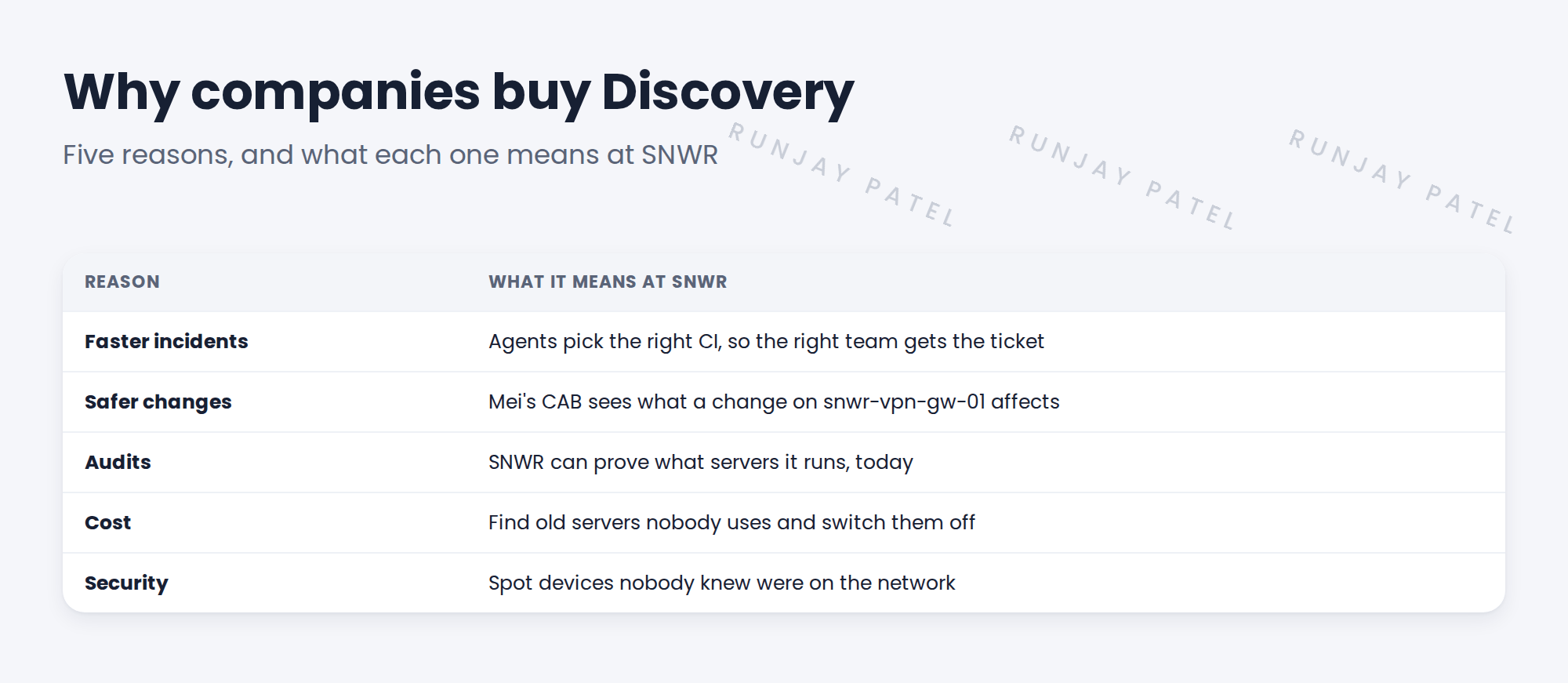
2 Five reasons companies buy Discovery
- Faster incidents. When a CI is on the incident, it goes to the right team faster.
- Safer changes. The CMDB shows what a change could break, before it happens.
- Audits. Auditors ask what you run. Discovery gives a fresh answer.
- Cost. Old, forgotten servers still cost money. Discovery finds them.
- Security. An unknown device is a risk. Discovery finds devices nobody listed.
💡 Good to know: Clients rarely buy Discovery for its own sake. They buy it because ITSM, security or finance needs good CMDB data.
3 What Discovery doesn’t fix
Be honest with the client about the limits. This builds trust.
- It can’t decide who owns a server. People still set owners and support groups.
- It can’t fix a broken process. If agents skip the CI field, the data doesn’t help.
- It only sees what it can reach. A device behind a closed firewall stays unknown.
- It doesn’t draw full service maps. That’s a separate product, Service Mapping.
💡 Good to know: Need a refresher? See ITSM Implementation › CMDB Usage › CIs on Incidents, Problems and Changes for how ITSM uses CIs.
4 Project Clear View: How We Implemented It
📍 Situation: Anita wants a one-page value summary before kickoff. She will show it to the board.
🧭 Decision: Tie each reason to a pain SNWR already has, and give it a number to measure.
🛠️ Steps we took:
- Listed SNWR’s pains: empty CI fields, the 62-server spreadsheet, the VPN outage, and no list of unknown devices.
- Found today’s numbers with Hana. Only 40% of incidents have a CI. Server completeness in the CMDB is 41%.
- Set a target for each. For example, incidents with a CI above 75% one month after go-live.
- Wrote the limits too, such as ‘Discovery won’t set owners’.
✅ What we verified:
- Hana checked that today’s numbers are correct.
- Anita agreed the targets are fair and can be measured.
📁 Evidence: The Clear View value summary. Its targets become acceptance criteria later (see Requirements Gathering › Defining Acceptance Criteria).
5 Quick recap
- Companies buy Discovery for faster incidents, safer changes, audits, cost and security.
- Discovery can’t set owners, fix processes or reach devices it can’t connect to.
- Give every benefit a number you can measure before and after.
- Be honest about limits. It builds the client’s trust.
6 Check yourself
Think of your answer first. Then tap to check.
1 Name two reasons companies buy Discovery. Show answer
Any two of: faster incidents, safer changes, audits, lower cost, better security.
2 Why did you measure ‘40% of incidents have a CI’ before starting? Show answer
So you can prove the change after go-live. Without a starting number, you can’t show value.
3 Can Discovery tell SNWR who owns snwr-mail-01? Show answer
No. Discovery finds technical facts. People set owners and support groups.
Nice work! You can explain why a client pays for Discovery. 🎉
Next up: A Discovery Project from Kickoff to Handover
Was this lesson helpful?
Please log in to share lesson feedback.
Have a question or doubt?
Ask here and get help from instructors and fellow learners.
Only logged-in learners can post.





