


Collecting and Parsing Data
On this page
In this lesson, you will learn:
- How to read a configuration file
- How to parse key and value lines
- Handling missing values
🔁 Quick look back: Last time: Designing the Identification Section. You learned how the archiver’s identification section finds the app.
1 The Problem: The Values Live in a Config File
The archiver’s version, port and archive path aren’t in any command output. They’re in /opt/snwr-archiver/archiver.conf. So:
- The pattern must read the file.
- Then pick out three values.
👉 The fix: Use Parse File with a key-and-value strategy.
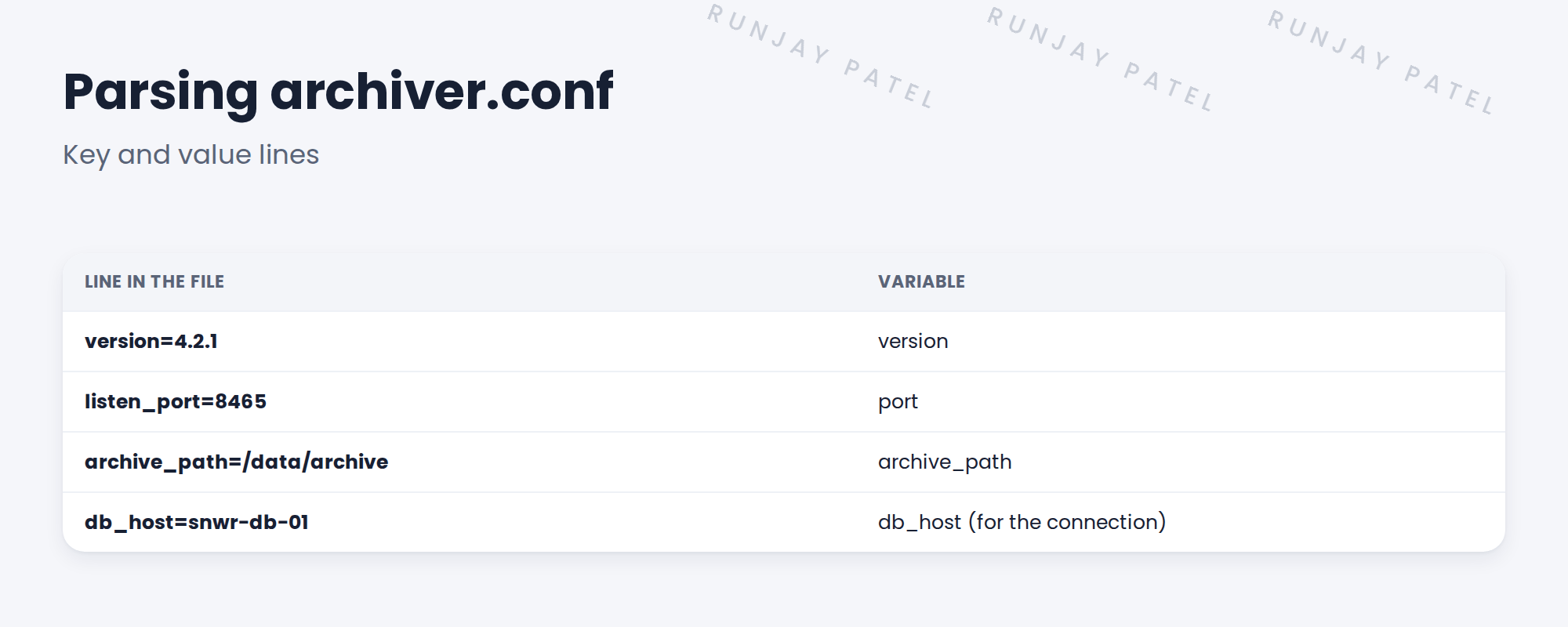
2 Reading and parsing
- Add a Parse File step for /opt/snwr-archiver/archiver.conf.
- Use the key-and-value strategy with ‘=’ as the separator.
- Map each key to a variable.
The account needs read access to the file. Add it to the privilege matrix if needed.
3 Missing values
- Decide what happens if a key is missing: leave the field empty, don’t guess.
- Log a warning so it’s visible in debugging.
4 Project Clear View: How We Implemented It
📍 Situation: The values were in archiver.conf.
🧭 Decision: Parse the file into variables.
🛠️ Steps we took:
- Added a Parse File step for archiver.conf.
- Used key and value with ‘=’.
- Mapped version, listen_port, archive_path and db_host.
- Confirmed snowdisc can read the file.
✅ What we verified:
- All four variables fill in Debug.
- Priya added read access to the privilege matrix.
📁 Evidence: The parse step, part of the archiver pattern.
5 Quick recap
- Parse File reads a file on the target.
- Key and value is simplest for ‘key=value’ lines.
- The account needs read access to the file.
- Leave missing values empty; don’t guess.
6 Check yourself
Think of your answer first. Then tap to check.
1 Which operation reads archiver.conf? Show answer
Parse File.
2 Which separator does the file use? Show answer
The equals sign (=).
3 What if a key is missing? Show answer
Leave the field empty and log a warning.
Nice work! The pattern collects the archiver’s values. 🎉
Next up: Populating Attributes and Relationships
Was this lesson helpful?
Please log in to share lesson feedback.
Have a question or doubt?
Ask here and get help from instructors and fellow learners.
Only logged-in learners can post.





