


Clusters, Load Balancing and Failover
On this page
In this lesson, you will learn:
- What a MID Server cluster is
- Load balancing vs failover
- SNWR’s Mumbai cluster
🔁 Quick look back: Last time: How ServiceNow Selects a MID Server. You learned how ServiceNow picks the MID Server for each scan.
1 The Problem: One MID Server Is a Single Point of Failure
If snwr-mid-mum-01 goes down during patching:
- The Mumbai nightly scan doesn’t run.
- Nobody notices until the data is old.
👉 The fix: Put two MID Servers in a cluster, so one can cover for the other.
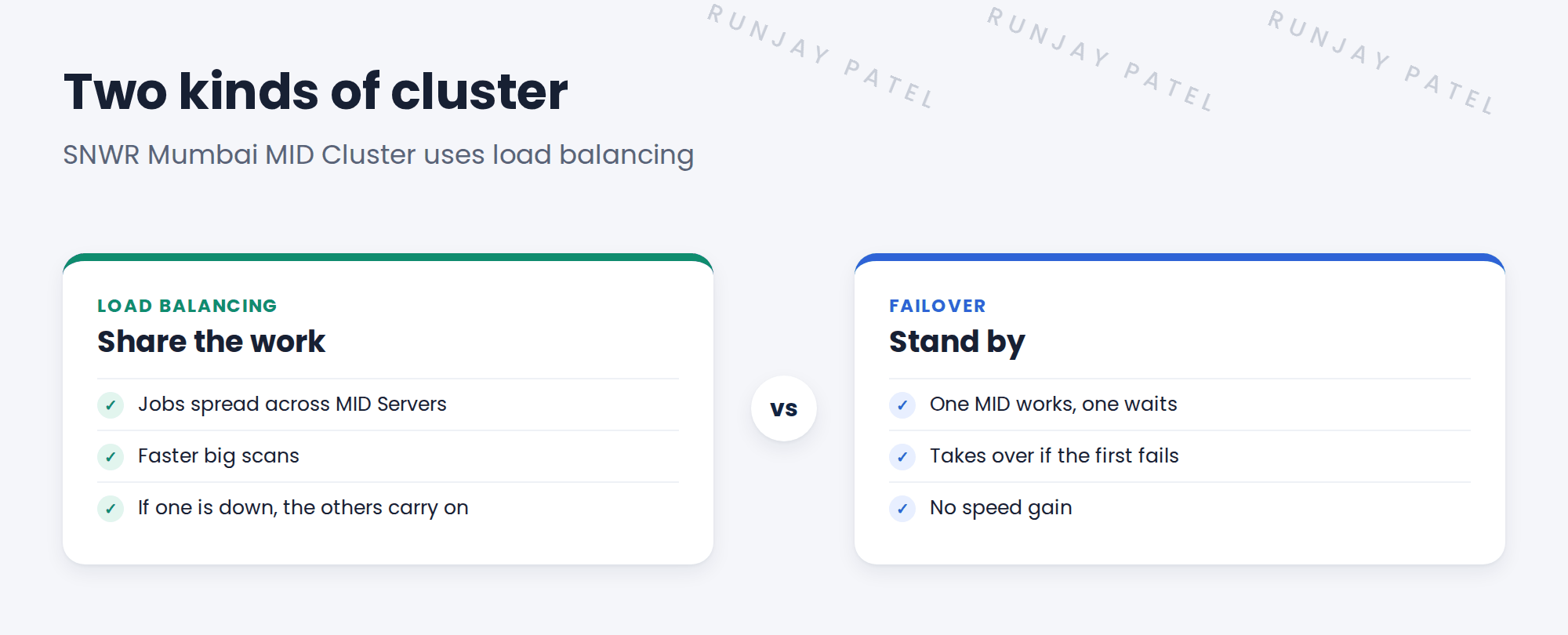
2 Cluster types
Key term: MID Server cluster
A group of MID Servers that a schedule can use as one.
Key term: Load balancing cluster
Shares jobs across its members.
Key term: Failover cluster
Uses one member; another takes over if it fails.
Cluster members should have the same applications, ranges and capabilities.
3 Choosing
- Busy site with many devices: load balancing.
- Small site that must not stop: failover.
- Both need at least two MID Servers.
4 Project Clear View: How We Implemented It
📍 Situation: Priya patches the Mumbai hosts monthly.
🧭 Decision: Create a load-balancing cluster with both Mumbai MID Servers.
🛠️ Steps we took:
- Created SNWR Mumbai MID Cluster as load balancing.
- Added snwr-mid-mum-01 and 02 with matching settings.
- Pointed the Mumbai schedule to the cluster.
- Tested by stopping one MID and running a Quick Discovery.
✅ What we verified:
- The scan ran on the other MID Server.
- Both members have matching ranges and capabilities.
📁 Evidence: Cluster settings and test result in the runbook.
5 Quick recap
- A cluster lets several MID Servers act as one.
- Load balancing shares the work. Failover stands by.
- Members need matching settings.
- Test by stopping one member.
6 Check yourself
Think of your answer first. Then tap to check.
1 What’s the difference between load balancing and failover? Show answer
Load balancing shares jobs. Failover uses one and switches if it fails.
2 Which type does SNWR use in Mumbai? Show answer
Load balancing.
3 How did you test the cluster? Show answer
Stopped one MID Server and ran a Quick Discovery. The other one ran it.
Nice work! SNWR’s Mumbai scans survive one MID failure. 🎉
Next up: DNS, Proxy and Network-Zone Considerations
Was this lesson helpful?
Please log in to share lesson feedback.
Have a question or doubt?
Ask here and get help from instructors and fellow learners.
Only logged-in learners can post.





