


How Discovered Data Reaches the CMDB
On this page
In this lesson, you will learn:
- Why Discovery doesn’t write CIs directly
- What IRE does in three steps
- How IRE prevents duplicates
🔁 Quick look back: Last time: Patterns: How Discovery Explores a Device. You learned what a pattern is and where pattern updates come from.
1 The Problem: Discovery Could Create Duplicates
SNWR’s CMDB already has snwr-mail-01, typed in by hand. Hana worries:
- ‘Will Discovery create a second snwr-mail-01?’
- ‘Will it overwrite what my team typed?’
👉 The fix: Discovery sends its data through IRE, which checks before it writes.
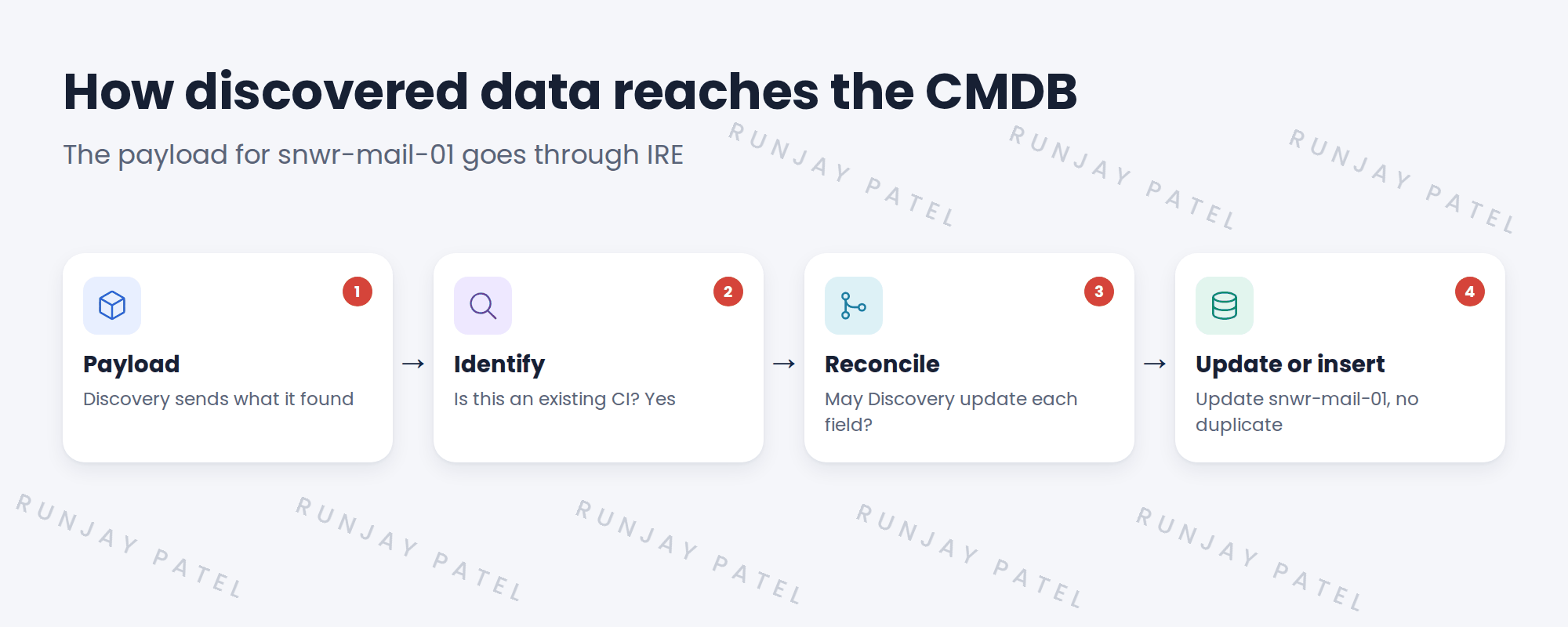
2 IRE in three steps
IRE is the Identification and Reconciliation Engine. Every source that writes CIs, including Discovery, should go through it.
- Identify. IRE uses identification rules, such as serial number or name, to find a matching CI.
- Reconcile. IRE checks which source may update which fields.
- Update or insert. If it found a match, it updates it. If not, it creates a new CI.
💡 Good to know: Need a refresher? See Fundamentals › CMDB Essentials › CMDB Health & Maintenance for the IRE basics.
3 Why this matters on a project
- Good identification rules stop duplicates.
- Reconciliation rules protect data people own, like support groups.
- If the old CMDB data is poor, IRE may not find a match. That’s why you check the CMDB before scanning.
📝 Note: You’ll go much deeper into IRE in CMDB Readiness, before any design decisions.
4 Project Clear View: How We Implemented It
📍 Situation: Hana is afraid Discovery will create duplicates of her hand-made CIs.
🧭 Decision: Explain IRE now, and plan a CMDB check before any scan.
🛠️ Steps we took:
- Showed Hana the three IRE steps using snwr-mail-01.
- Explained that IRE matches on serial number first, then name.
- Pointed out that her spreadsheet CIs have no serial numbers, so matching relies on names.
- Added a CMDB readiness check to the plan, before design.
✅ What we verified:
- Hana understood why her data must be checked first.
- The CMDB readiness check is in the plan for weeks 2-3.
📁 Evidence: A new task in the plan: the CMDB readiness review (see CMDB Readiness › The Project Clear View CMDB Readiness Review).
5 Quick recap
- Discovery sends its data to IRE instead of writing CIs directly.
- IRE identifies, reconciles, then updates or inserts.
- Good identification rules prevent duplicates.
- Poor existing data makes matching harder, so check the CMDB first.
6 Check yourself
Think of your answer first. Then tap to check.
1 What does IRE stand for? Show answer
Identification and Reconciliation Engine.
2 What does the reconcile step decide? Show answer
Which source may update which fields on the CI.
3 Why might IRE fail to match SNWR’s spreadsheet CIs? Show answer
They have no serial numbers, so matching relies on names, which may be written differently.
Nice work! You know how Discovery data reaches the CMDB. 🎉
Next up: Discovery Methods: IP-Based, Cloud API, ACC and Credential-less Options
Was this lesson helpful?
Please log in to share lesson feedback.
Have a question or doubt?
Ask here and get help from instructors and fellow learners.
Only logged-in learners can post.





