


Reading the Statement of Work
On this page
In this lesson, you will learn:
- The parts of a statement of work (SOW)
- What SNWR-SOW-014 includes and leaves out
- Which questions to send back before kickoff
🔁 Quick look back: Last time: Where a Discovery Implementer Works in ServiceNow. You learned the three places you work in ServiceNow.
1 The Problem: The SOW Decides What You Owe
The SOW is the contract between your company and SNWR. Later, someone will ask for ‘just one more thing’. For example:
- Arjun may ask for a map of SNWR Email.
- Someone may ask to scan all 1,400 laptops.
- Hana may expect you to fix every old CI by hand.
👉 The fix: Read the SOW line by line before kickoff, and ask about anything unclear.
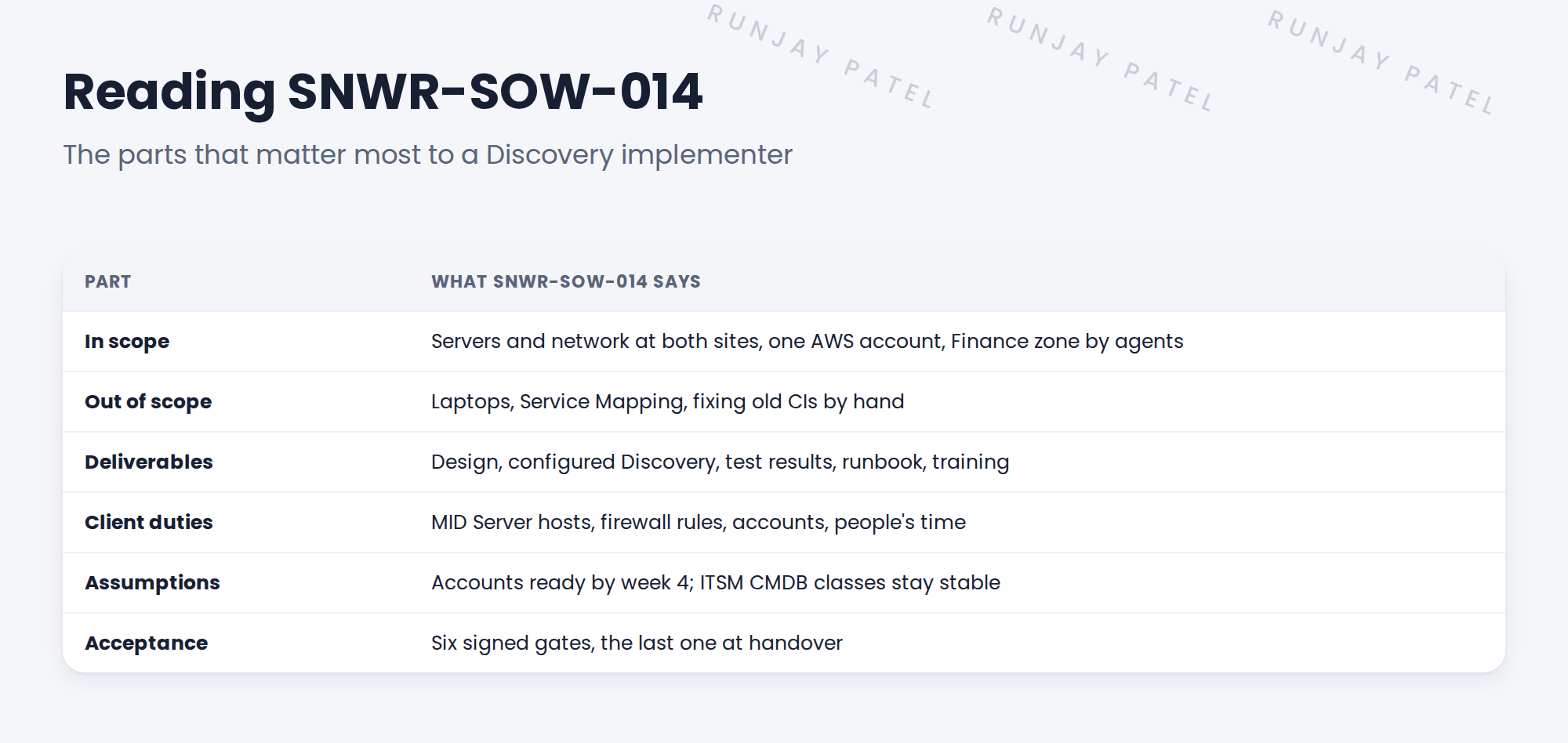
2 The parts of an SOW
Key term: Scope
What you’ll deliver. Anything not listed is not included.
Key term: Assumptions
Things everyone believes will be true. If one breaks, the plan may change.
Key term: Client duties
What the client must provide, such as servers and accounts.
Key term: Change request
The formal way to add or change scope, with cost and time agreed.
⚠️ Scope creep: If a request isn’t in the SOW, don’t just say yes. Log it and raise a change request if SNWR wants it.
3 Questions to ask before kickoff
- Does ‘network devices’ include printers and Wi-Fi access points?
- Who fixes the old CIs that Discovery can’t match?
- Is Kubernetes in scope, or only the EKS cluster itself?
Send these to Hana in writing. Keep the answers with the SOW.
4 Project Clear View: How We Implemented It
📍 Situation: You have SNWR-SOW-014 and kickoff is in five days.
🧭 Decision: Read it line by line, and turn every unclear line into a question.
🛠️ Steps we took:
- Highlighted the scope, out of scope, deliverables and client duties.
- Found three unclear lines and wrote them as questions for Hana.
- Noted the assumption that accounts arrive by week 4. You added it to the risks.
- Filed the SOW and Hana’s answers in the project folder.
✅ What we verified:
- Hana answered all three questions in writing: printers are out, SNWR fixes old CIs with your help, only the EKS cluster is in.
- You can say in one sentence what Clear View does and doesn’t include.
📁 Evidence: SOW review notes and Hana’s written answers. The assumption about accounts becomes A-01 in the RAID log (see Kickoff Call › Risks, Assumptions and Dependencies).
5 Quick recap
- The SOW says what you owe. Anything not listed is out of scope.
- Read scope, out of scope, deliverables, client duties, assumptions and acceptance.
- Turn unclear lines into written questions.
- New requests go through a change request.
6 Check yourself
Think of your answer first. Then tap to check.
1 Arjun asks for a map of SNWR Email. What do you do? Show answer
Explain it’s out of scope in the SOW, log the request, and suggest a change request if SNWR wants it.
2 What is an assumption in an SOW? Show answer
Something everyone expects to be true, like ‘accounts ready by week 4’. If it breaks, the plan may change.
3 Why ask your questions in writing? Show answer
So the answers are clear and can be checked later.
Nice work! You know what Clear View owes SNWR. 🎉
Next up: Checking Licenses and Subscription Units
Was this lesson helpful?
Please log in to share lesson feedback.
Have a question or doubt?
Ask here and get help from instructors and fellow learners.
Only logged-in learners can post.





