


Risks, Assumptions and Dependencies
On this page
In this lesson, you will learn:
- What a RAID log is
- Common Discovery risks
- How to keep the log useful
🔁 Quick look back: Last time: The Project Plan and Timeline. You learned how to build the 12-week plan around gates and dependencies.
1 The Problem: Surprises Stall Discovery Projects
Discovery projects often stall for the same reasons:
- A firewall change is slower than planned.
- A zone turns out to block scans.
- Accounts arrive late or with too few rights.
👉 The fix: Keep a RAID log from week 1, and review it every week.
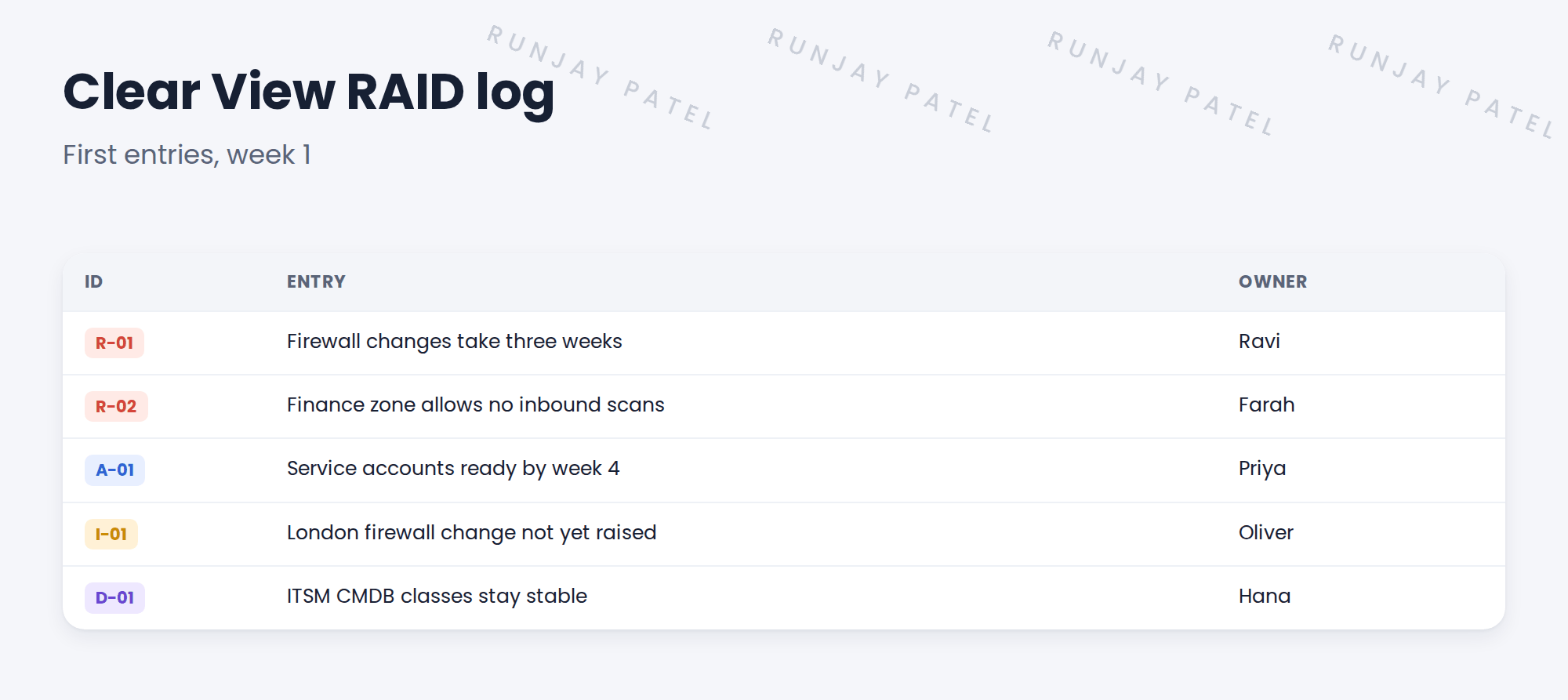
2 R, A, I and D
Key term: Risk
Something that might go wrong.
Key term: Assumption
Something you believe is true but haven’t proved.
Key term: Issue
Something that has already gone wrong.
Key term: Dependency
Something you need from someone else.
Each entry has an owner, a date and what you’ll do about it.
3 Common Discovery risks
- Slow firewall or change approvals.
- Accounts with too few rights.
- Zones that block inbound connections.
- A messy CMDB that creates duplicates.
- Security concerns raised late.
4 Project Clear View: How We Implemented It
📍 Situation: After kickoff, you had a list of worries in your notes.
🧭 Decision: Turn them into a RAID log and review it at every Thursday status call.
🛠️ Steps we took:
- Wrote the first five entries, each with an owner.
- Added an action for each risk. For R-02: plan agents for Finance.
- Shared the log with Hana.
- Agreed to review it every Thursday.
✅ What we verified:
- Every entry has an owner and an action.
- R-02 already shaped the design idea to use agents.
📁 Evidence: The Clear View RAID log, reviewed weekly.
5 Quick recap
- RAID means risks, assumptions, issues and dependencies.
- Every entry needs an owner and an action.
- Common Discovery risks: slow approvals, weak accounts, blocked zones, messy CMDB.
- Review the log every week.
6 Check yourself
Think of your answer first. Then tap to check.
1 What’s the difference between a risk and an issue? Show answer
A risk might happen. An issue has already happened.
2 Give one common Discovery risk. Show answer
Any of: slow firewall approvals, accounts with too few rights, blocked zones, a messy CMDB, late security concerns.
3 What did R-02 lead to? Show answer
The idea to use ACC agents for the Finance zone.
Nice work! Clear View’s risks are visible and owned. 🎉
Next up: Governance and Status Reporting
Was this lesson helpful?
Please log in to share lesson feedback.
Have a question or doubt?
Ask here and get help from instructors and fellow learners.
Only logged-in learners can post.





