


How IRE Identifies an Existing CI
On this page
In this lesson, you will learn:
- How IRE looks for a matching CI
- What happens with one match, many, or none
- Why clean data matters for matching
🔁 Quick look back: Last time: Assessing the Existing CMDB Before Discovery. You learned how to assess the existing CMDB before the first scan.
1 The Problem: Discovery Must Recognise Servers It Already Knows
When Discovery finds snwr-mail-01, the CMDB already has a record for it. Discovery must:
- Recognise that it’s the same server.
- Update that record, not add a new one.
👉 The fix: IRE compares the data with identification rules to find the existing CI.
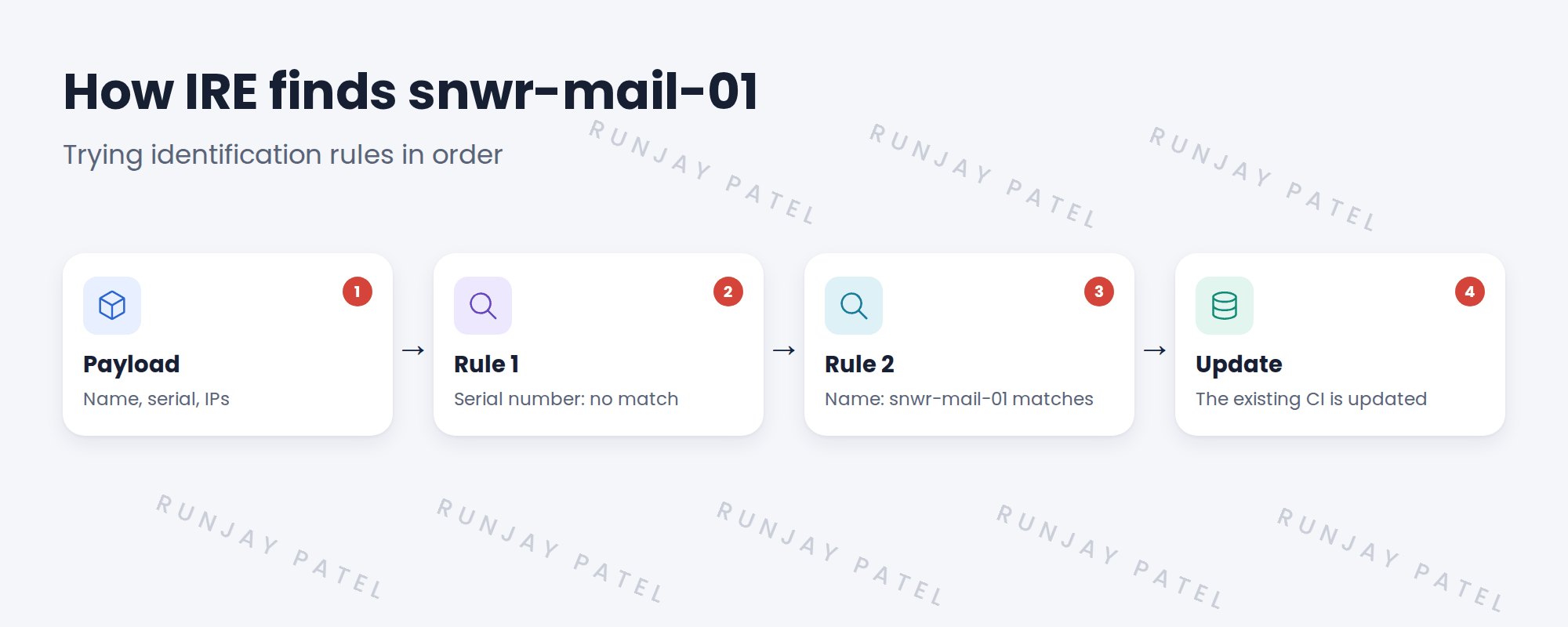
2 How matching works
- Discovery sends a payload with the device’s details.
- IRE picks the identification rule for the class.
- It tries the rule’s entries in order, such as serial number, then name.
- It stops at the first entry that finds a match.
| Result | What IRE does |
|---|---|
| One match | Updates that CI. |
| No match | Creates a new CI. |
| More than one match | Flags a duplicate. It doesn’t guess. |
3 Why clean data matters
If the old CI’s name is ‘SNWR-MAIL-01.snwr.local’ and Discovery reports ‘snwr-mail-01’, they may not match. Then IRE creates a new CI.
💡 Good to know: Check how Discovery will format names, and clean old names to match before scanning.
4 Project Clear View: How We Implemented It
📍 Situation: SNWR’s CIs have no serial numbers, so IRE will match on names.
🧭 Decision: Check that old names will match what Discovery reports.
🛠️ Steps we took:
- Compared spreadsheet names with the real hostnames on 10 servers.
- Found 7 names with a domain suffix or different case.
- Agreed with Hana to clean those names before the pilot.
- Noted that after the first scan, serial numbers will help matching.
✅ What we verified:
- Cleaned names match real hostnames on the test servers.
- Hana owns the name cleanup task.
📁 Evidence: A name cleanup task in the CMDB readiness report.
5 Quick recap
- IRE uses identification rules to find a matching CI.
- It tries entries in order and stops at the first match.
- No match creates a new CI. Many matches flag a duplicate.
- Clean names before scanning if serial numbers are missing.
6 Check yourself
Think of your answer first. Then tap to check.
1 What does IRE do when it finds exactly one match? Show answer
It updates that CI.
2 What does IRE do when it finds two matches? Show answer
It flags a duplicate instead of guessing.
3 Why did SNWR clean names before the pilot? Show answer
There were no serial numbers, so matching relied on names that had to match the real hostnames.
Nice work! You know how IRE recognises a known CI. 🎉
Next up: Identification Rules
Was this lesson helpful?
Please log in to share lesson feedback.
Have a question or doubt?
Ask here and get help from instructors and fellow learners.
Only logged-in learners can post.





