


MID Server Sizing, Threads and Performance
On this page
In this lesson, you will learn:
- What limits MID Server speed
- What worker threads are
- How SNWR kept scans under 3 hours
🔁 Quick look back: Last time: DNS, Proxy and Network-Zone Considerations. You learned how DNS, proxies and zones affect a MID Server.
1 The Problem: The Nightly Scan Runs Too Long
AC-06 says the nightly scan must finish in under 3 hours. In early tests:
- The Mumbai scan took almost 4 hours.
- The MID Server’s memory was near full.
👉 The fix: Size MID Servers properly and tune threads carefully.
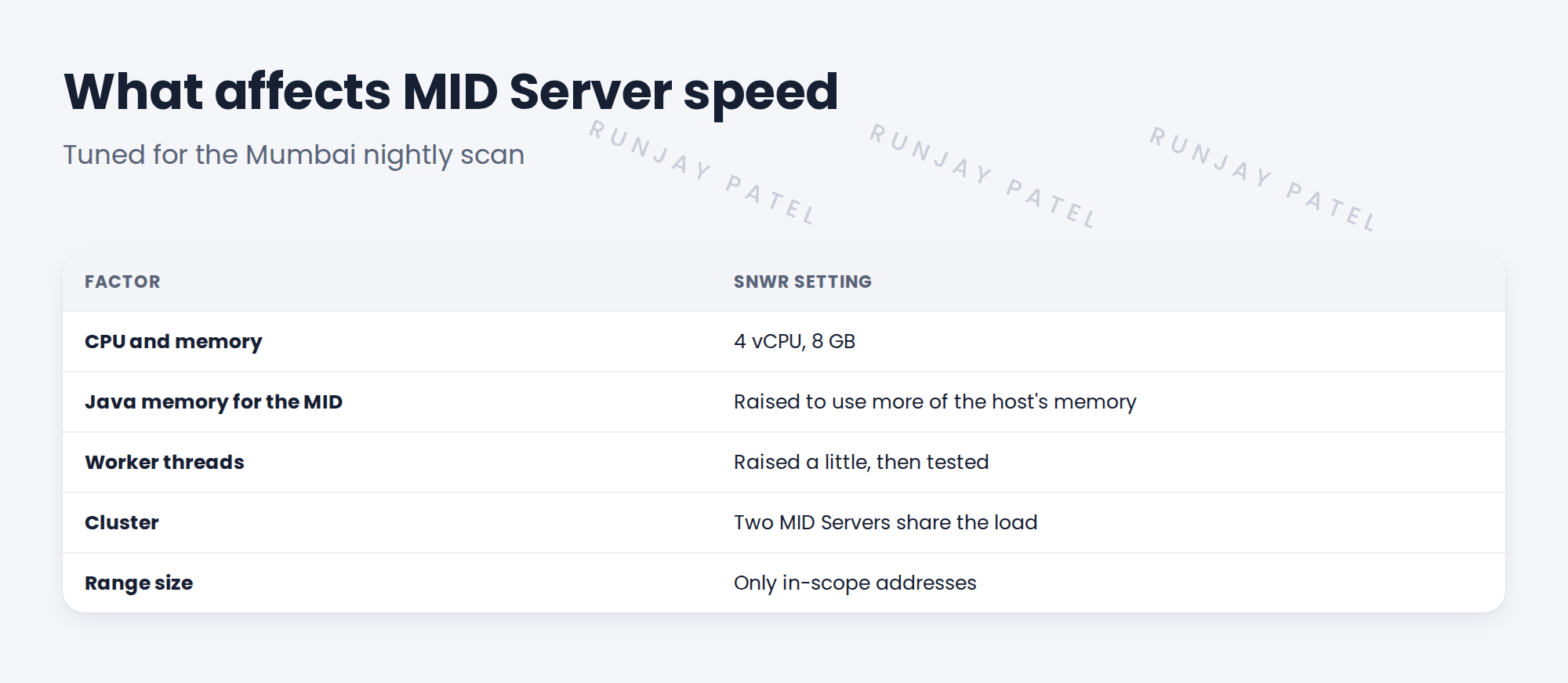
2 What limits speed
- Host CPU and memory.
- The memory the MID Server’s Java process may use.
- The number of worker threads.
- How many addresses you scan.
- Slow networks and slow targets.
Key term: Worker thread
One job the MID Server can run at the same time. More threads mean more parallel work, and more memory.
3 Tuning safely
- Measure first: how long, how much memory.
- Remove addresses that don’t need scanning.
- Add a cluster member if needed.
- Raise memory, then threads, a little at a time.
- Measure again.
⚠️ Heads up: Too many threads can run the MID Server out of memory and make it slower. Change one thing at a time.
4 Project Clear View: How We Implemented It
📍 Situation: The Mumbai scan took almost 4 hours.
🧭 Decision: Tune step by step and measure each change.
🛠️ Steps we took:
- Removed unused addresses from the range.
- Used both Mumbai MID Servers through the cluster.
- Raised the MID’s Java memory, then threads slightly.
- Measured after each change.
✅ What we verified:
- The scan now takes 2 hours 10 minutes.
- Memory use stays below 75%.
📁 Evidence: A tuning record in the runbook. AC-06 is tested in Quality Assurance.
5 Quick recap
- Speed depends on host size, MID memory, threads, range size and the network.
- Measure before and after each change.
- Change one thing at a time.
- Too many threads can make things worse.
6 Check yourself
Think of your answer first. Then tap to check.
1 What’s a worker thread? Show answer
One job the MID Server can run at the same time.
2 What did SNWR change first? Show answer
Removed unused addresses from the range.
3 How long does the Mumbai scan take now? Show answer
2 hours 10 minutes.
Nice work! SNWR’s nightly scan fits its window. 🎉
Next up: Hardening the MID Server
Was this lesson helpful?
Please log in to share lesson feedback.
Have a question or doubt?
Ask here and get help from instructors and fellow learners.
Only logged-in learners can post.





