


Assessing the Existing CMDB Before Discovery
On this page
In this lesson, you will learn:
- What to measure in the existing CMDB
- Where to find the numbers
- What SNWR’s CMDB looked like
🔁 Quick look back: Last time: Relationships Discovery Creates. You learned which relationships Discovery creates, and which need Service Mapping.
1 The Problem: Nobody Has Checked the CMDB in Years
SNWR’s CMDB was loaded once from a spreadsheet. Since then:
- Some servers were retired but never removed.
- Some were added twice.
- Nobody has measured its quality.
👉 The fix: Measure it now: counts, completeness, duplicates, sources and classes.
2 What to measure
- How many CIs of each class.
- How complete the required fields are.
- How many duplicates exist.
- Which sources write to the CIs.
- How old the data is.
Use CMDB Workspace, the CMDB Health dashboard, and simple list filters.
3 Reading the results
| If you find… | Then… |
|---|---|
| Many duplicates | Merge them before scanning. |
| No serial numbers | Matching will rely on names. Check names carefully. |
| An active import | Decide if it stays, and at what priority. |
💡 Good to know: Need a refresher? See Fundamentals › CMDB Essentials › CMDB Health & Maintenance for the Health dashboard.
4 Project Clear View: How We Implemented It
📍 Situation: You need facts about SNWR’s CMDB before design.
🧭 Decision: Run a short assessment with Hana in week 2.
🛠️ Steps we took:
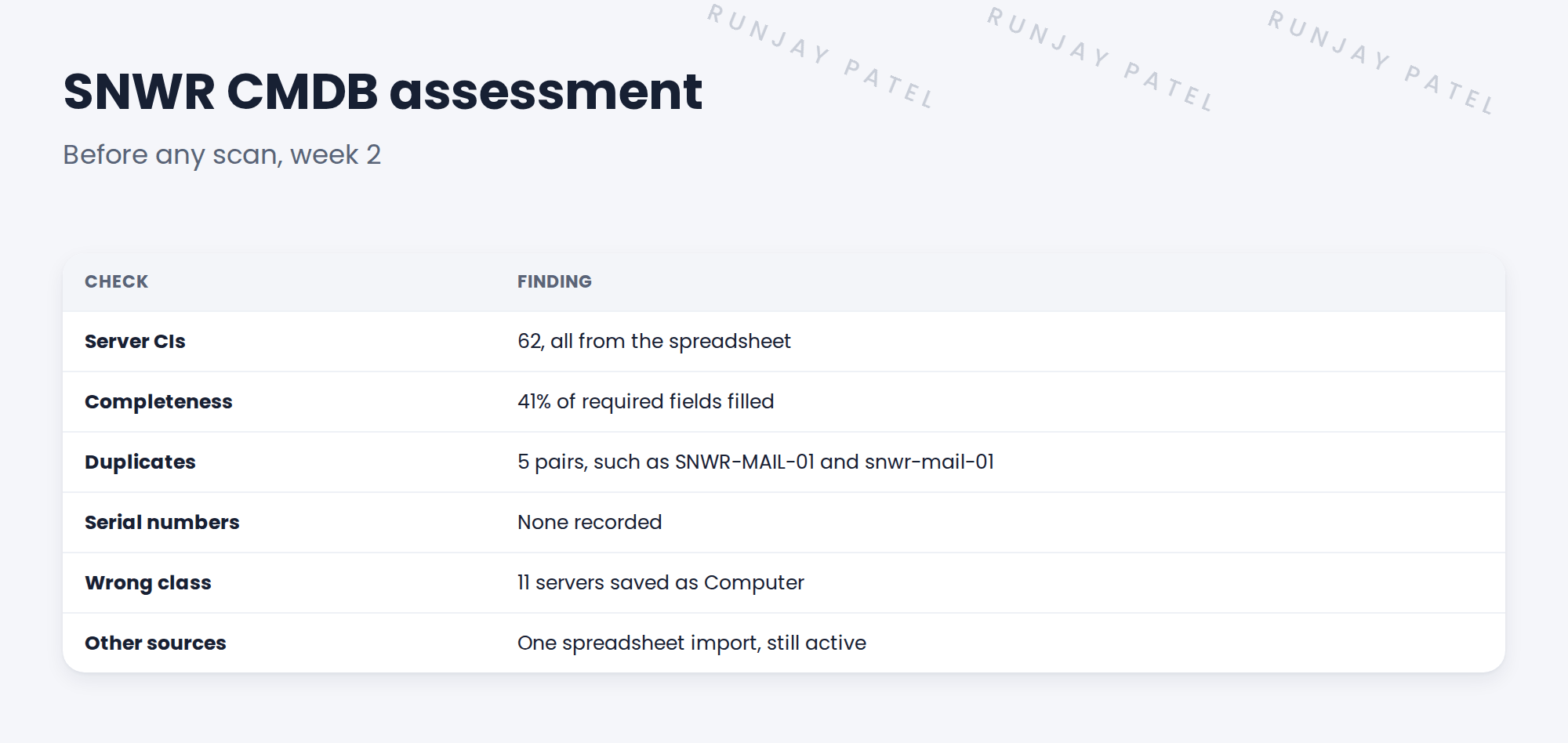
- Counted server CIs by class in CMDB Workspace.
- Read completeness from the CMDB Health dashboard.
- Searched for duplicate names, ignoring case.
- Checked which sources update server CIs.
✅ What we verified:
- Hana confirmed each finding.
- Every finding has an action.
📁 Evidence: The assessment table, the first part of the CMDB readiness report.
5 Quick recap
- Measure counts, completeness, duplicates, sources and age.
- Use CMDB Workspace, the Health dashboard and list filters.
- SNWR had 5 duplicate pairs and no serial numbers.
- Every finding needs an action.
6 Check yourself
Think of your answer first. Then tap to check.
1 Name three things to measure in an existing CMDB. Show answer
Any three of: counts by class, completeness, duplicates, sources, age.
2 SNWR’s CIs had no serial numbers. What does that mean? Show answer
IRE must match on names, so names must be checked carefully.
3 How many duplicate pairs did SNWR have? Show answer
Five.
Nice work! You know what SNWR’s CMDB really looks like. 🎉
Next up: How IRE Identifies an Existing CI
Was this lesson helpful?
Please log in to share lesson feedback.
Have a question or doubt?
Ask here and get help from instructors and fellow learners.
Only logged-in learners can post.





