


Knowledge Transfer Sessions
On this page
In this lesson, you will learn:
- What KT should cover
- How to run hands-on sessions
- SNWR’s four sessions
🔁 Quick look back: Last time: Keeping Pattern Content Up to Date. You learned how SNWR will handle pattern content updates.
1 The Problem: A Document Alone Doesn’t Build Skill
The runbook is written. But reading isn’t doing. Hana’s team still needs to:
- Fix a real failure.
- Change a schedule safely.
- Maintain the archiver pattern.
👉 The fix: Run hands-on KT sessions where Hana’s team does the work.
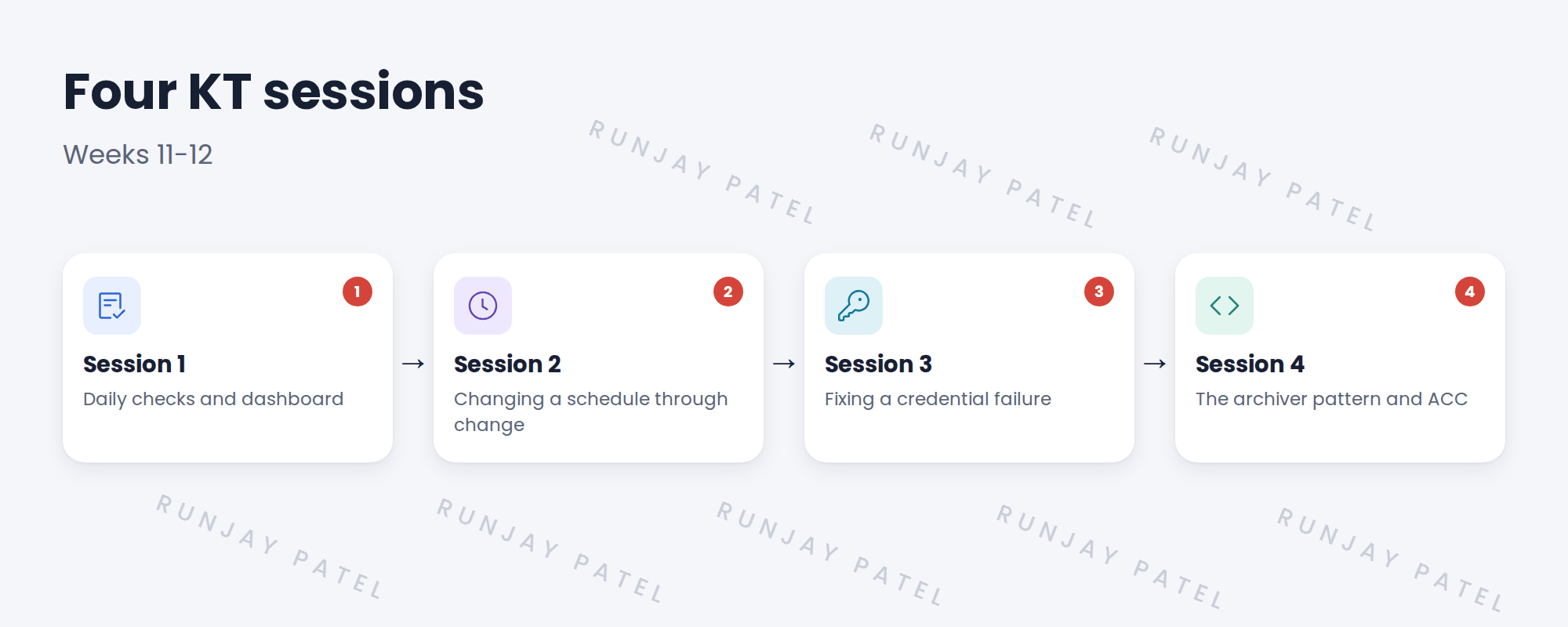
2 Planning KT
- Base sessions on real tasks.
- Let the client do the work while you watch.
- Record sessions if allowed.
- Check skills at the end.
3 After KT
Agree which topics the team is confident with, and which need support. Record any gaps in the handover.
4 Project Clear View: How We Implemented It
📍 Situation: Handover was near.
🧭 Decision: Run four hands-on sessions with Hana’s team.
🛠️ Steps we took:
- Planned four sessions on real tasks.
- Hana’s team drove each session.
- Recorded them for new staff.
- Checked skills with a short task at the end.
✅ What we verified:
- The team did every task themselves.
- One gap (pattern debugging) got an extra session.
📁 Evidence: KT records, part of the closure report.
5 Quick recap
- KT builds skill, not just knowledge.
- Base sessions on real tasks.
- Let the client do the work.
- Record gaps and follow up.
6 Check yourself
Think of your answer first. Then tap to check.
1 Why hands-on KT? Show answer
Reading isn’t doing; the team must practise real tasks.
2 What was SNWR’s fourth session? Show answer
The archiver pattern and ACC.
3 Which gap needed an extra session? Show answer
Pattern debugging.
Nice work! Hana’s team can run Discovery. 🎉
Next up: Showing the Value and Closing the Project
Was this lesson helpful?
Please log in to share lesson feedback.
Have a question or doubt?
Ask here and get help from instructors and fellow learners.
Only logged-in learners can post.





