


Revisiting the Acceptance Criteria
On this page
In this lesson, you will learn:
- Why testing starts from the acceptance criteria
- How each criterion becomes a test
- SNWR’s checklist
🔁 Quick look back: Last time: Troubleshooting ACC. You learned how an offline agent was brought back.
1 The Problem: Testing Without a Target Proves Nothing
It’s week 9. Everything seems to work. But ‘seems to work’ isn’t proof. Without a target:
- Everyone judges success differently.
- Gate 5 can’t be signed fairly.
👉 The fix: Test against the acceptance criteria SNWR agreed in week 2.
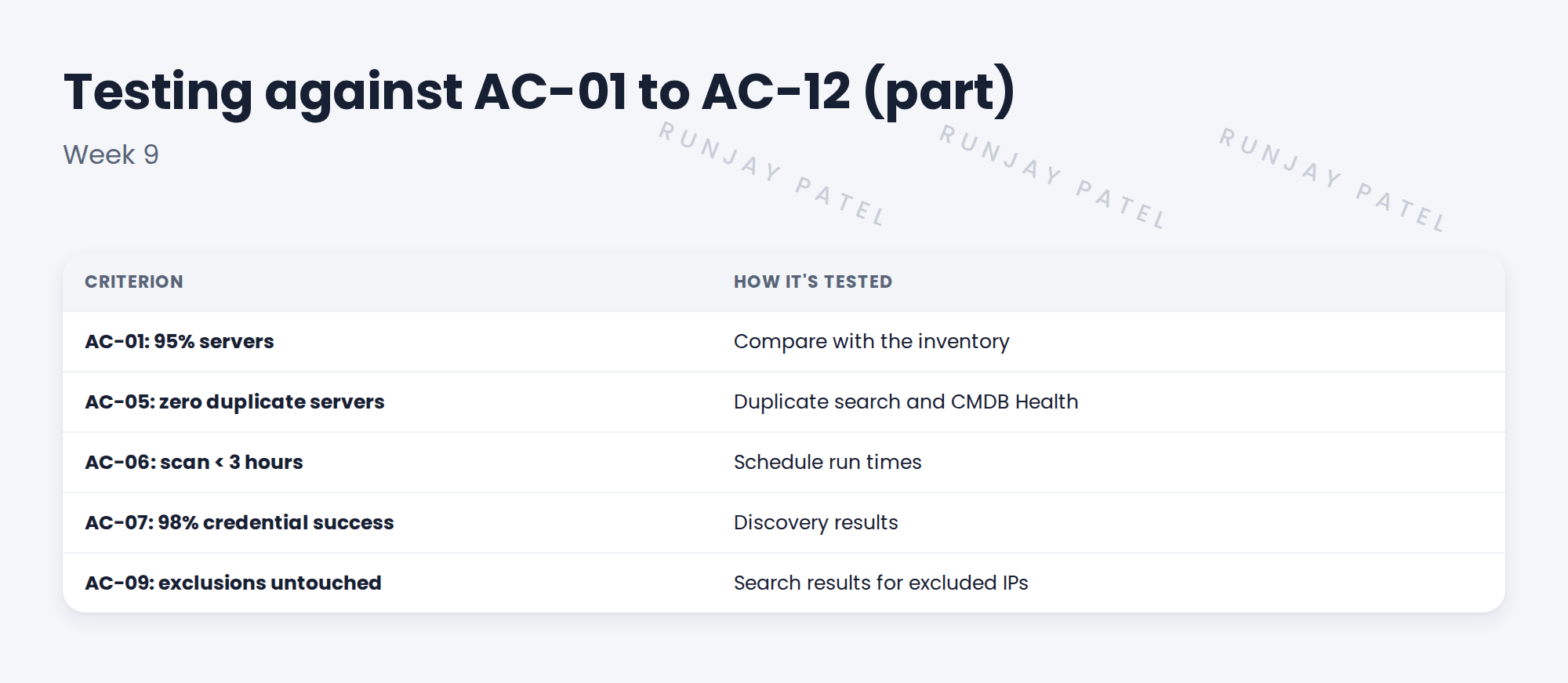
2 From criteria to tests
- List every acceptance criterion.
- Write how you’ll measure each one.
- Decide the evidence you’ll show.
- Run the tests and record results.
3 Why this matters
⭐ Remember: Hana agreed these criteria before the build. Meeting them is the fairest proof that Clear View worked.
4 Project Clear View: How We Implemented It
📍 Situation: Testing starts in week 9.
🧭 Decision: Turn AC-01 to AC-12 into the testing checklist.
🛠️ Steps we took:
- Listed the twelve criteria.
- Wrote a measure and evidence for each.
- Agreed the checklist with Hana.
- Linked each to test cases in the test plan.
✅ What we verified:
- Every criterion has a test.
- Hana agreed the checklist.
📁 Evidence: The acceptance checklist, part of the test plan.
5 Quick recap
- Test against the criteria agreed in requirements.
- Each criterion needs a measure and evidence.
- Agree the checklist with the client.
- Meeting agreed criteria is the fairest proof.
6 Check yourself
Think of your answer first. Then tap to check.
1 Why test against the acceptance criteria? Show answer
They’re the target the client agreed before the build.
2 How is AC-09 tested? Show answer
By searching results for excluded IP addresses.
3 When were the criteria agreed? Show answer
Week 2, during Requirements Gathering.
Nice work! Clear View’s testing has a clear target. 🎉
Next up: Writing the Test Plan
Was this lesson helpful?
Please log in to share lesson feedback.
Have a question or doubt?
Ask here and get help from instructors and fellow learners.
Only logged-in learners can post.





