


Reconciliation and Data Source Precedence
On this page
In this lesson, you will learn:
- What reconciliation rules do
- What data source precedence means
- SNWR’s field ownership
🔁 Quick look back: Last time: Discovery Source and Data Sources. You learned how every CI records which source reported it.
1 The Problem: Two Sources Overwrite Each Other
Priya sets a server’s support group by hand. That night, another source writes a different value. Next day, Priya fixes it again. So:
- Fields flip back and forth.
- Nobody trusts the value.
👉 The fix: Use reconciliation rules to say which source owns each field.
2 Reconciliation in plain words
Key term: Reconciliation rule
Says which sources may update which fields of a class.
Key term: Data source precedence
When several sources may update a field, which one wins. A lower number usually means higher priority.
Key term: Data refresh rule
Stops a source from updating a field if another source reported it recently.
⭐ Remember: Give each field one clear owner. Shared fields cause flip-flopping.
3 Common patterns
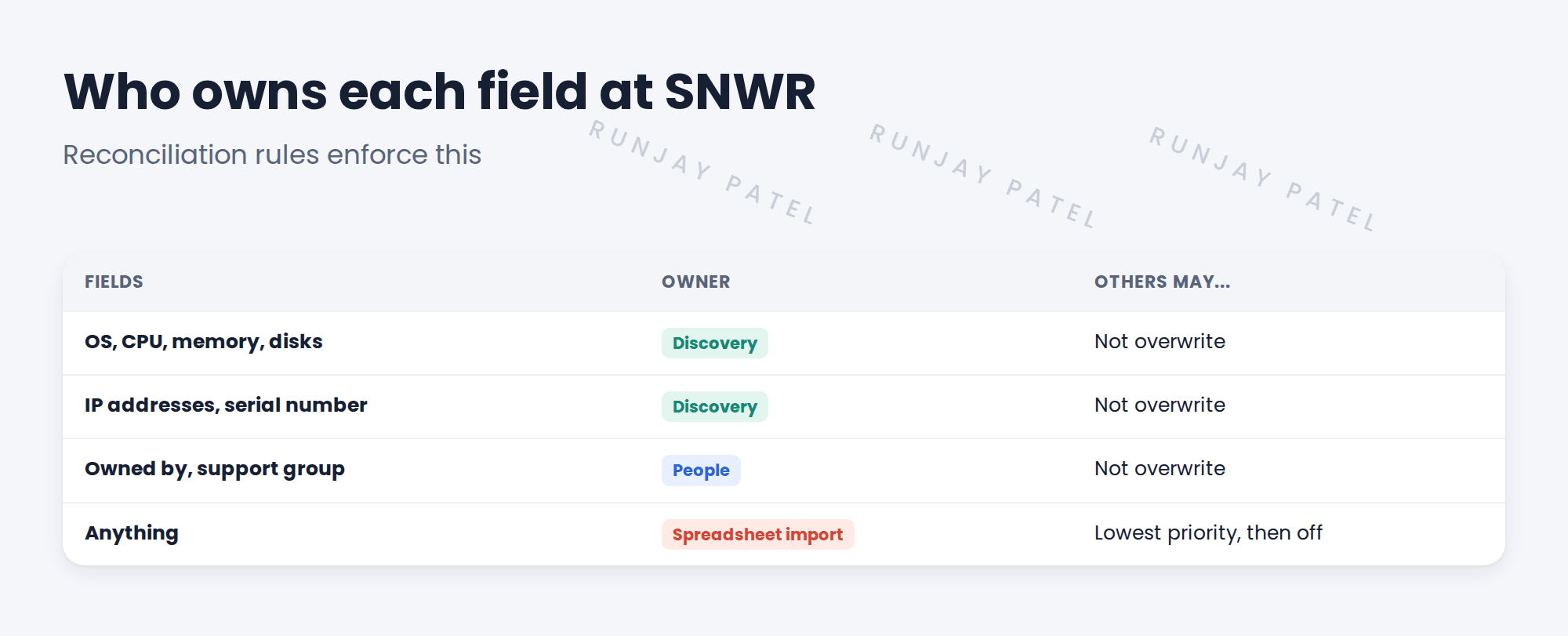
- Discovery owns technical fields it can see.
- People own business fields: owners, support groups, cost centres.
- Imports get the lowest priority, or are switched off.
4 Project Clear View: How We Implemented It
📍 Situation: Hana wants to protect the fields her team sets by hand.
🧭 Decision: Agree field ownership now, and build rules from it in design.
🛠️ Steps we took:
- Listed the fields on server CIs that matter to SNWR.
- Gave each field one owner: Discovery or people.
- Set the spreadsheet import to lowest priority until it’s switched off.
- Recorded the table for design.
✅ What we verified:
- Hana and Priya agreed who owns each field.
- No field has two owners.
📁 Evidence: Field ownership table, used for DD-D05 (see Solution Design › Designing CMDB and Identification Decisions).
5 Quick recap
- Reconciliation rules say which source may update which fields.
- Data source precedence decides who wins when several may update.
- Give each field one owner.
- At SNWR, Discovery owns technical fields and people own business fields.
6 Check yourself
Think of your answer first. Then tap to check.
1 What does a reconciliation rule do? Show answer
It says which sources may update which fields of a class.
2 Who owns the support group field at SNWR? Show answer
People (Priya’s team), not Discovery.
3 What’s a data refresh rule for? Show answer
It stops a source updating a field another source reported recently.
Nice work! SNWR’s fields each have one owner. 🎉
Next up: CI Reclassification
Was this lesson helpful?
Please log in to share lesson feedback.
Have a question or doubt?
Ask here and get help from instructors and fellow learners.
Only logged-in learners can post.





