


Who’s Who on an ITSM Project
On this page
In this lesson, you will learn:
- The main roles on an ITSM project
- Who does each job at SNWR
- How a RACI chart shows who decides
- Why the implementer advises but doesn’t decide
🔁 Quick look back: Last time: Implementation Phases, from Kickoff to Hypercare. You learned the five Now Create phases, and how Execute runs in two-week sprints with a demo at the end of each.
1 “Who decides this?”
It’s week 2 of One Front Door. You’re designing emergency changes.
- Mei wants every emergency change approved by the emergency CAB.
- Daniel wants his team to fix outages first and approve later.
- They both look at you. You pick one, and the other one is upset for a week.
👉 The fix: name one owner for every process, and write down who decides, who helps and who just needs to know.
2 The main roles
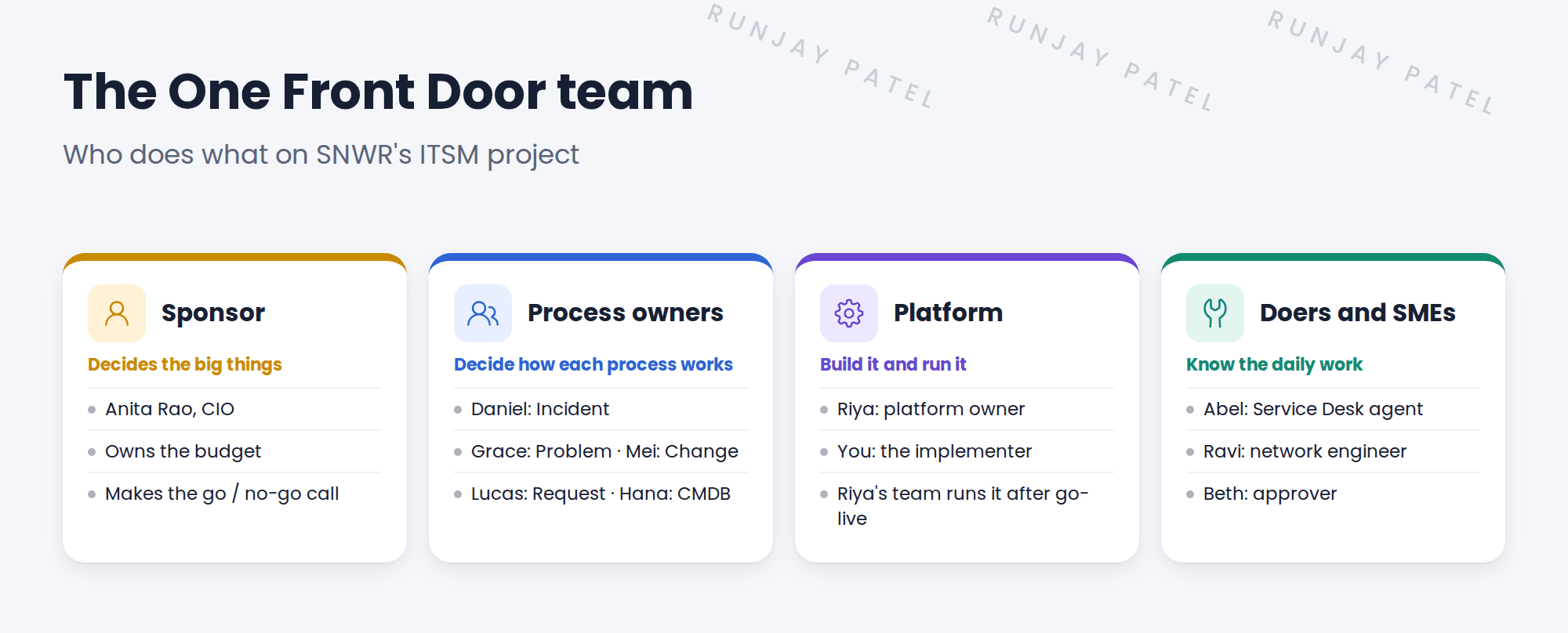
Key term: Executive sponsor
The senior leader who pays for the project and makes the big calls.
Key term: Process owner
The person in charge of one process, like Change. They decide how it works.
Key term: Platform owner
The person who runs ServiceNow day to day, and owns it after go-live.
Key term: SME
Subject matter expert. Someone who does the work every day and knows the details, like an agent.
3 Who decides what at SNWR
| Decision | Who decides |
|---|---|
| Which incidents count as major | Daniel (Incident process owner) |
| Who approves high-risk changes | Mei (Change process owner) |
| What goes in the service catalog | Lucas (Request process owner) |
| Go live or wait a week | Anita (sponsor) |
| How ServiceNow is set up to do it | You and Riya, within what the owners decided |
📝 Note: The process owner decides what the process should do. You decide how to set it up in ServiceNow, and you advise them on the best way.
4 A RACI chart makes it clear
A RACI chart lists a task and marks each person with one letter.
Key term: RACI
Responsible (does the work), Accountable (owns the result, one person only), Consulted (asked for input), Informed (told about it).
| Task: design emergency changes | R | A | C | I |
|---|---|---|---|---|
| You (implementer) | ✔ | |||
| Mei (Change owner) | ✔ | |||
| Daniel (Incident owner) | ✔ | |||
| Abel (agent) | ✔ |
Now the emergency change question has a clear answer. You design it. Daniel gives his input. Mei decides.
💡 Good to know: There is only ever one A for each task. Two owners means no owner.
5 Your job as the implementer
- 🧭 AdviseShow the options and what ServiceNow does out of the box
- ✍️ RecordWrite down each decision and who made it
- 🛠️ BuildSet up what the owner decided
⚠️ Heads up: Don’t make business decisions for the process owners, even when they ask you to. Give them options and a recommendation. Let them choose.
⭐ Remember: Owners decide what. You advise, record and build.
6 Quick recap
- The sponsor pays for the project and makes the big calls
- Each process has one process owner who decides how it works
- The platform owner runs ServiceNow after go-live
- SMEs know the daily work
- A RACI chart shows who does, owns, helps and is told
- The implementer advises, records and builds
7 Check yourself
Think of your answer first. Then tap to check.
1 Mei and Daniel disagree about emergency changes. Who decides? Show answer
Mei, the Change process owner. Daniel is consulted.
2 What does the A in RACI stand for, and how many can a task have? Show answer
Accountable. Only one person per task.
3 Who runs ServiceNow at SNWR after go-live? Show answer
Riya Sharma, the platform owner, and her team.
4 Anita asks you: should we go live this week? Who makes that call? Show answer
Anita. She’s the sponsor. You give her the facts.
Nice work! You know who’s who on One Front Door. 🎉
Next up: Scoping and Requirements Workshops
Was this lesson helpful?
Please log in to share lesson feedback.
Have a question or doubt?
Ask here and get help from instructors and fellow learners.
Only logged-in learners can post.





