


What Makes an Incident Major at SNWR
On this page
In this lesson, you will learn:
- What a major incident is
- SNWR’s major incident criteria
- Why P1 and major are separate decisions
- Who decides if an incident is major
🔁 Quick look back: Last time: Legacy Agent Experiences: UI16 and Agent Workspace. You learned how to recognize the classic form and the older Agent Workspace, and why new setups use Service Operations Workspace.
1 It’s 9:40 on Monday
SNWR Email stops working at Mumbai HQ.
- Forty people log incidents in ten minutes.
- Three agents work on it separately.
- Nobody tells Anita. She finds out from her own team.
👉 The fix: agree clear criteria for a major incident, so everyone knows when to switch to the major incident process.
2 What is a major incident?
Key term: Major incident
An incident so big that it needs a leader, a team and regular updates, not just one agent.
Key term: Major incident manager
The person who leads a major incident. At SNWR, that’s Daniel.
Key term: Major incident criteria
The agreed rules for when an incident counts as major.
ServiceNow doesn’t decide what’s major for you. Each company sets its own criteria.
3 SNWR’s criteria
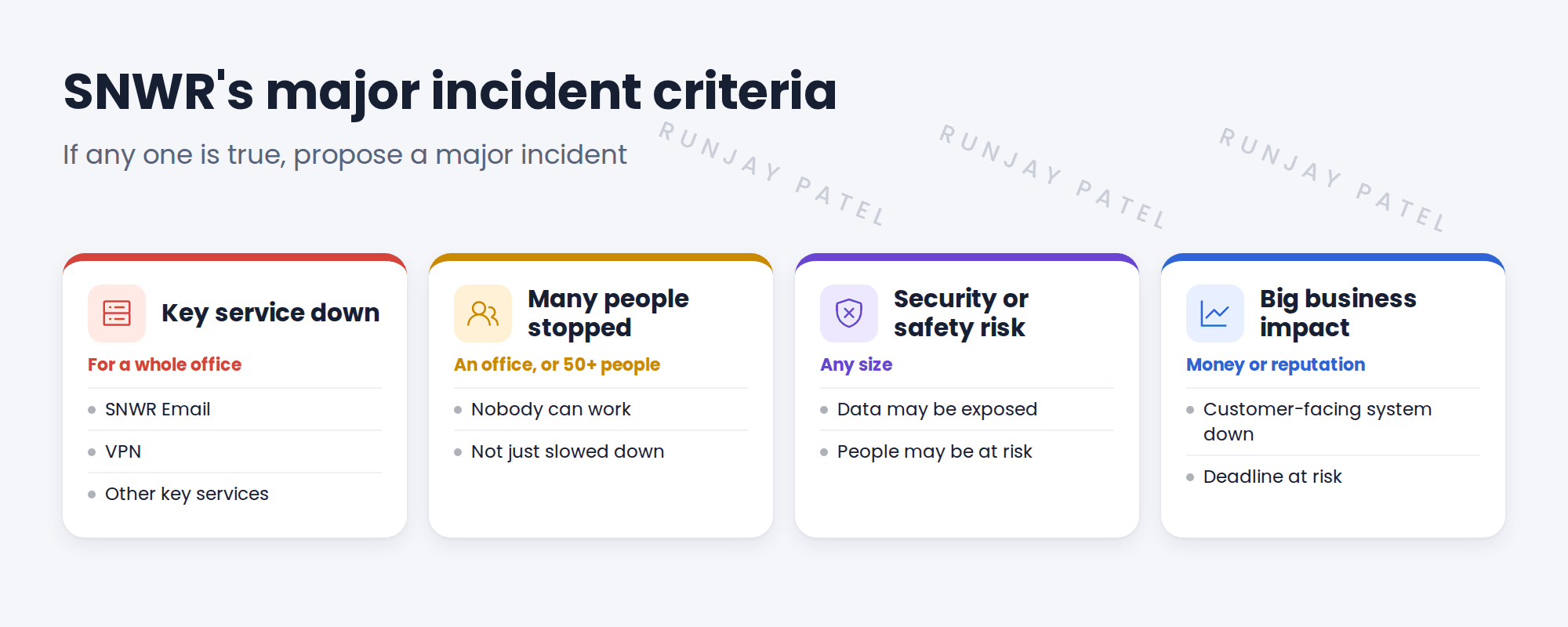
📝 Note: Daniel signed these off as decision DD-015.
4 P1 is not the same as major
| Case | Priority | Major? |
|---|---|---|
| SNWR Email down for all of Mumbai HQ | P1 | Yes |
| The CFO’s laptop won’t start before a board meeting | P1 or P2 (high urgency) | No: one person, one agent can fix it |
| A suspected data leak, only 3 users so far | P2 | Yes: security risk |
Priority sets the SLA and the queue order. Major status starts a different process: a leader, a team, a plan and updates.
⭐ Remember: Priority says how fast. Major says how we organize.
5 Quick recap
- A major incident needs a leader, a team and regular updates
- Each company sets its own criteria
- SNWR: key service down, many people stopped, security risk or big business impact
- P1 isn’t automatically major, and a P2 can be major
- Daniel, the major incident manager, decides
6 Check yourself
Think of your answer first. Then tap to check.
1 Does ServiceNow decide what counts as a major incident? Show answer
No. Each company sets its own criteria.
2 Is every P1 a major incident? Show answer
No. Priority and major status are separate decisions.
3 A suspected data leak affects only 3 users. Could it be major? Show answer
Yes. A security risk is one of SNWR’s criteria.
4 Who decides if an incident is major at SNWR? Show answer
Daniel Okafor, the major incident manager.
Nice work! You know when an incident is major at SNWR. 🎉
Next up: Proposing and Promoting a Major Incident
Was this lesson helpful?
Please log in to share lesson feedback.
Have a question or doubt?
Ask here and get help from instructors and fellow learners.
Only logged-in learners can post.





