


How ServiceNow Works Out Change Risk
On this page
In this lesson, you will learn:
- Why change risk matters
- What a risk assessment is
- What risk conditions are
- How they combine for CHG0030045
🔁 Quick look back: Last time: Legacy Change Workflows. You learned how to recognize old change workflows, and that models and flows replace them today.
1 “Everything is Low risk”
In the old tool, the person raising a change picked its risk.
- Almost every change was marked Low.
- Risky changes skipped CAB.
- The worst outages came from “Low risk” changes.
👉 The fix: work out risk the same way every time, from questions and rules.
2 Two ways ServiceNow sets risk
Key term: Risk assessment
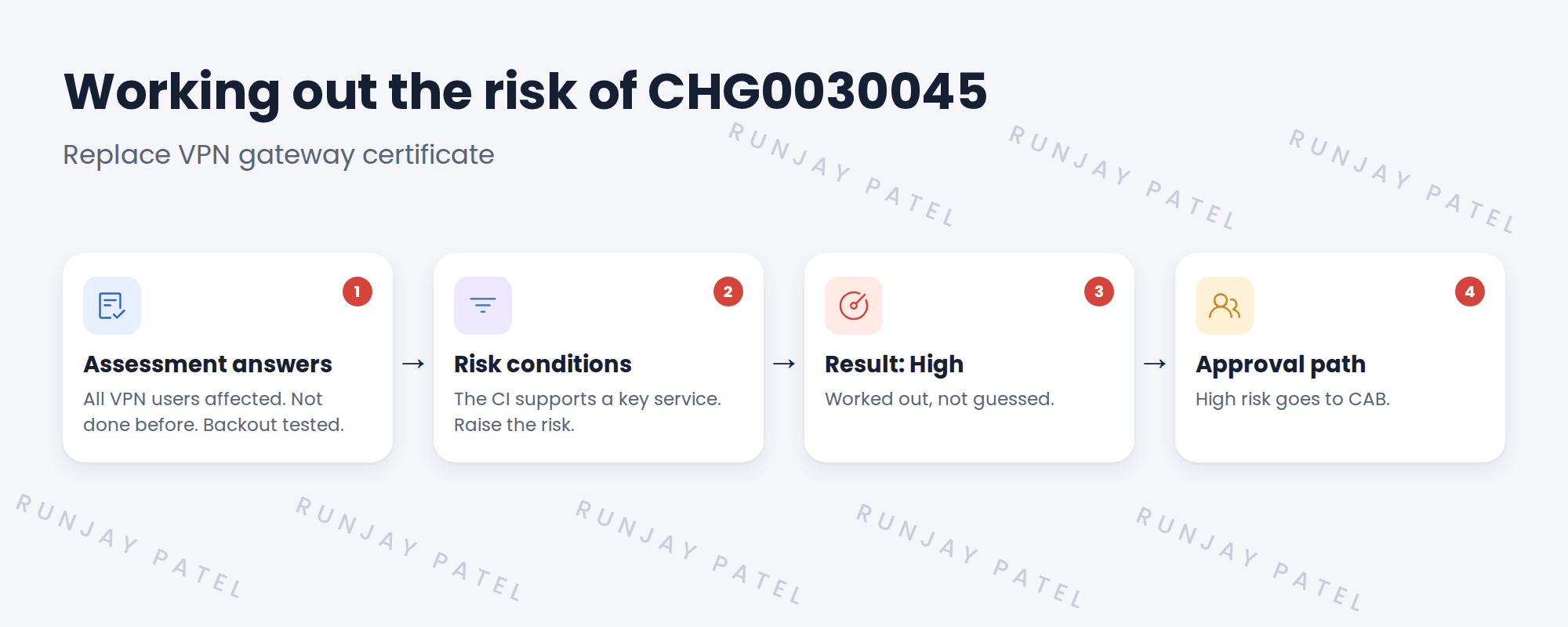
A short set of questions the change owner answers, like “Has this been done before?”
Key term: Risk conditions
Rules that raise the risk automatically, like “the CI supports a key service”.
Key term: Risk
The final result: for example Low, Moderate or High.
3 Why it matters
| Risk | What happens at SNWR |
|---|---|
| Low | Manager approval only |
| Moderate | Manager and change manager |
| High | CAB approval |
You’ll build these rules in the Change Approvals chapter. Risk is the input that picks the path.
⭐ Remember: Answers plus rules give the risk. Risk picks the approval path.
4 Quick recap
- Guessed risk is usually too low
- A risk assessment asks the owner simple questions
- Risk conditions raise risk automatically
- Together they give the change’s risk
- Risk decides who approves
5 Check yourself
Think of your answer first. Then tap to check.
1 Why not let people pick the risk? Show answer
They usually guess too low.
2 What’s a risk condition? Show answer
A rule that raises the risk automatically, like the CI supporting a key service.
3 What was CHG0030045’s risk, and why? Show answer
High: it affects all VPN users, hasn’t been done before, and the CI supports a key service.
4 What does High risk mean at SNWR? Show answer
It needs CAB approval.
Nice work! You know how change risk is worked out. 🎉
Next up: Configuring Risk Assessments
Was this lesson helpful?
Please log in to share lesson feedback.
Have a question or doubt?
Ask here and get help from instructors and fellow learners.
Only logged-in learners can post.





