


Test Strategy for an ITSM Rollout
On this page
In this lesson, you will learn:
- Why a rollout needs a test plan
- The four kinds of testing
- Who tests on which instance
- What “done” means for testing
🔁 Quick look back: Last time: The Continual Improvement Cycle. You learned how SNWR runs the improvement cycle: baseline, target, review and improve.
1 “We’ll test it at the end”
On the last project, testing was left to the final week.
- Bugs were found two days before go-live.
- Fixes broke other things.
- Go-live moved by a month.
👉 The fix: test all the way through, in four kinds, each with an owner.
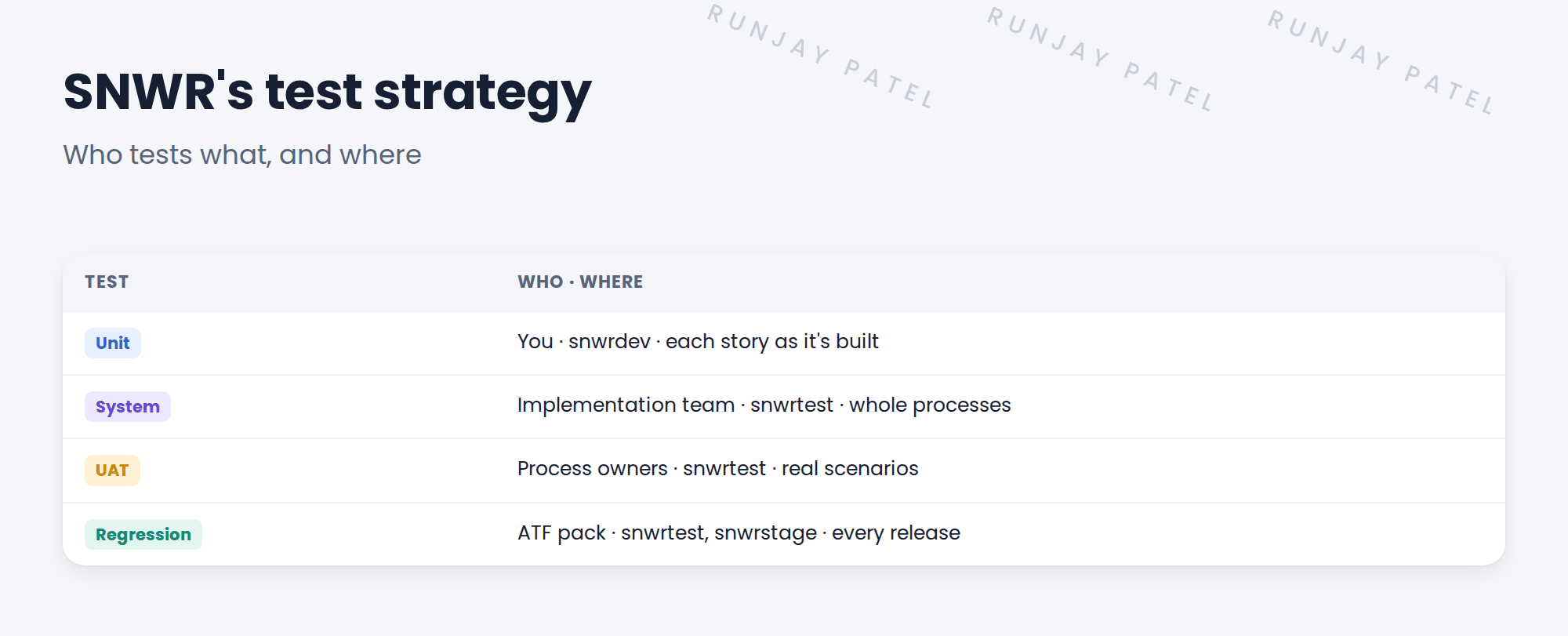
2 The four kinds
Key term: UAT
User acceptance testing: the people who will use it check it does what they need.
Key term: Regression testing
Re-testing what already worked, to check nothing broke.
3 When testing is done
- Every user story has passed its acceptance criteria.
- Every UAT script has been signed off by its process owner.
- No open defects marked critical or high.
- The regression pack passes on snwrstage.
⭐ Remember: Test early, test often, and write down who signed off.
4 Quick recap
- Unit: you, on snwrdev, as you build
- System: the team, whole processes, on snwrtest
- UAT: process owners, real scenarios, on snwrtest
- Regression: ATF, before every release
- Done = stories passed, UAT signed, no critical defects
5 Check yourself
Think of your answer first. Then tap to check.
1 Who runs UAT at SNWR? Show answer
The process owners, like Daniel.
2 On which instance do you unit test? Show answer
snwrdev.
3 What is regression testing? Show answer
Re-testing what already worked, to check nothing broke.
4 Can SNWR go live with a critical defect open? Show answer
No.
Nice work! You know how SNWR tests its rollout. 🎉
Next up: UAT Test Scripts with Process Owners
Was this lesson helpful?
Please log in to share lesson feedback.
Have a question or doubt?
Ask here and get help from instructors and fellow learners.
Only logged-in learners can post.





