


Change Architecture: Tables and State Model
On this page
In this lesson, you will learn:
- The main change tables
- The normal change states
- What happens in each state
- Where standard changes are stored
🔁 Quick look back: Last time: From Root Cause to Fix: Problem to Change. You learned how a problem raises a change to fix the cause, and is resolved when the change works.
1 “Who changed the server?”
Remember the Friday-night server change from the first lesson?
- Nobody asked first.
- Nobody planned a way back.
- Nobody recorded it, so on Monday nobody knew what had changed.
👉 The fix: record every change, and move it through clear states from idea to review.
2 The change tables
| Table | Holds | SNWR example |
|---|---|---|
change_request |
Each change | CHG0030045: Replace VPN gateway certificate |
change_task |
Work steps inside a change | Pre-check, implement, post-check |
| Standard change tables | Pre-approved templates and proposals | Restart SNWR mail service |
Change Request extends Task, like Incident and Problem. So it has assignment, state, work notes and approvals.
💡 Good to know: Need a refresher? See Fundamentals › ITSM Essentials › Change Management.
3 The normal change states
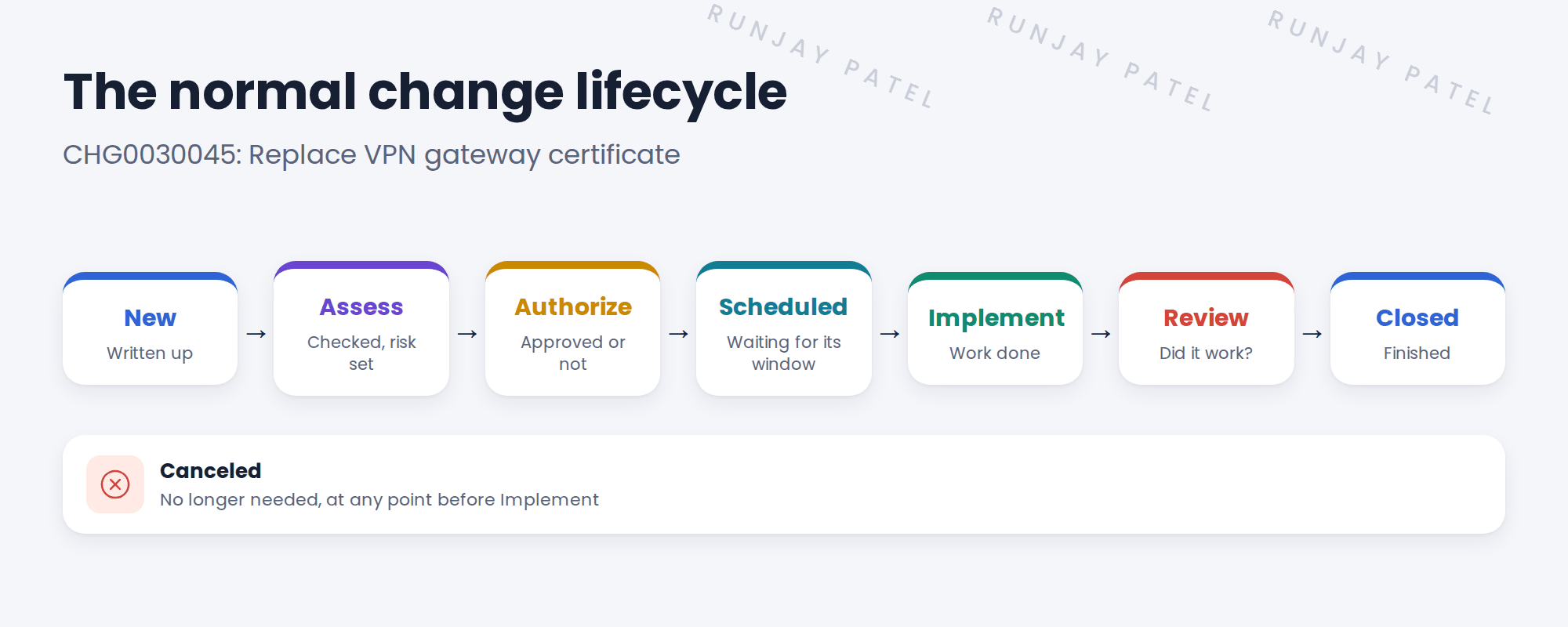
| State | At SNWR |
|---|---|
| New | Ravi writes the change, with plans |
| Assess | Mei checks it and the risk is set |
| Authorize | Beth and, if needed, CAB approve |
| Scheduled | Approved, waiting for Sunday’s window |
| Implement | Ravi does the work |
| Review | Did it work? Any problems? |
| Closed | Done, with a close code |
⭐ Remember: Every change is recorded, and moves through clear states.
4 Quick recap
- Changes live in change_request; steps in change_task
- Standard changes use their own template tables
- Normal states: New, Assess, Authorize, Scheduled, Implement, Review, Closed
- Change Request extends Task
- Every change is recorded
5 Check yourself
Think of your answer first. Then tap to check.
1 Which table holds each change? Show answer
change_request.
2 In which state do approvers say yes or no? Show answer
Authorize.
3 What happens in Review? Show answer
The team checks if the change worked.
4 Which table holds the work steps inside a change? Show answer
change_task.
Nice work! You know how Change Management is built. 🎉
Next up: Normal, Standard and Emergency Changes at SNWR
Was this lesson helpful?
Please log in to share lesson feedback.
Have a question or doubt?
Ask here and get help from instructors and fellow learners.
Only logged-in learners can post.





