


Problem Architecture and Lifecycle in Practice
On this page
In this lesson, you will learn:
- What a problem is, compared with an incident
- The problem states
- Who owns each step at SNWR
- The roles in problem management
🔁 Quick look back: Last time: Outages and Service Status for Employees. You learned how an outage record shows employees a known issue, and cuts duplicate incidents.
1 “The VPN broke again”
Sam’s VPN has dropped again. It’s the twelfth VPN incident this month.
- Each time, an agent resets the VPN client and it works for a while.
- Each incident is resolved, but the problem keeps coming back.
- Nobody is looking for the real cause.
👉 The fix: open a problem, and follow it through its states until the cause is found and fixed.
2 Incident vs problem
| Incident | Problem | |
|---|---|---|
| Goal | Get the person working again, fast | Find and fix the cause, for good |
| Example | INC0010101: Sam’s VPN drops | PRB0040012: recurring VPN drops |
| Owner | The Service Desk | Grace, the problem manager |
💡 Good to know: Need a refresher? See Fundamentals › ITSM Essentials › Problem Management.
3 The problem states
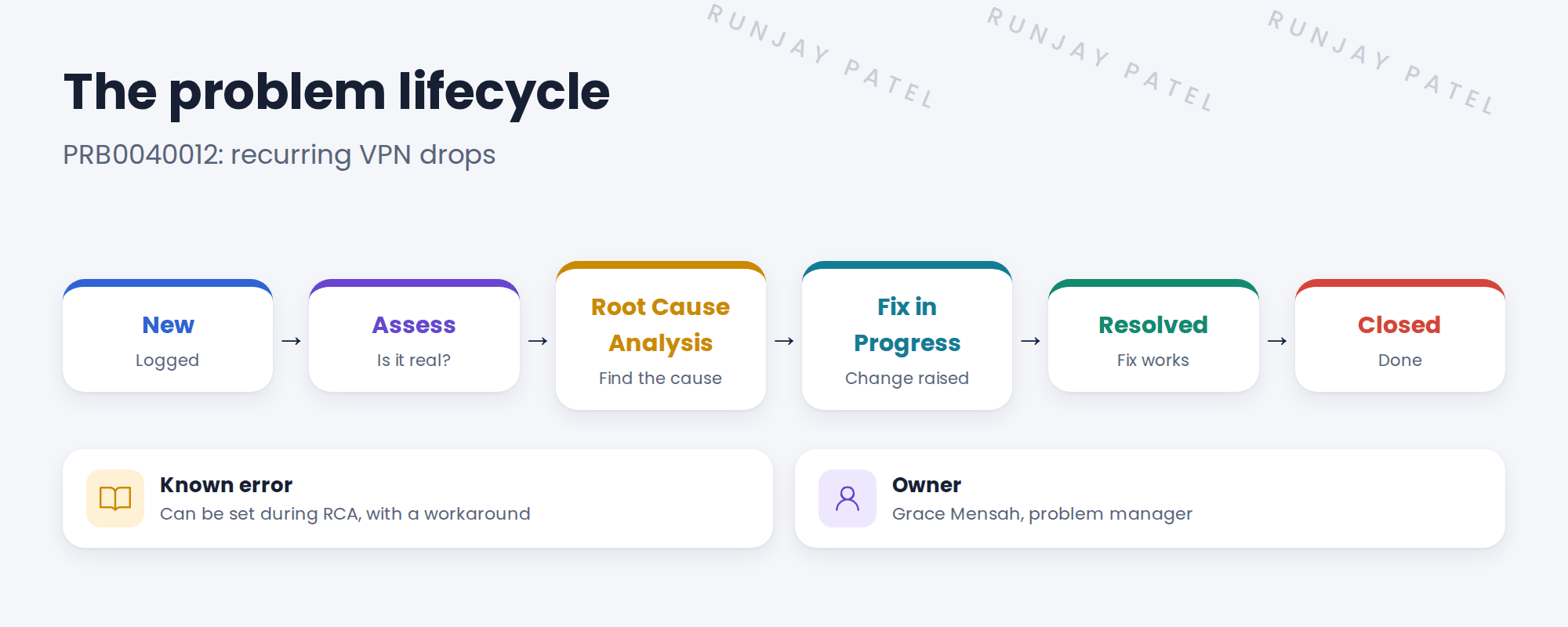
| State | What happens at SNWR | Who |
|---|---|---|
| New | Abel logs the problem from his incident | Service Desk |
| Assess | Grace confirms it’s real, and sets priority | Grace |
| Root Cause Analysis | The team investigates why | SNWR Network Support |
| Fix in Progress | A change is raised to fix the cause | Grace and Mei |
| Resolved · Closed | The fix works; the problem is finished | Grace |
4 Problem roles
Key term: Problem manager
Owns the problem process. At SNWR, Grace.
Key term: Problem coordinator
Runs each problem through its states. Also Grace, for now.
Key term: Problem task analyst
Works on tasks like root cause analysis. Ravi, for the VPN problem.
💡 Good to know: Check the role names on your instance. Problem Management has its own roles for coordinators and analysts.
⭐ Remember: Incidents fix symptoms. Problems fix causes.
5 Quick recap
- An incident fixes the symptom; a problem fixes the cause
- States: New, Assess, Root Cause Analysis, Fix in Progress, Resolved, Closed
- Grace is SNWR’s problem manager
- L2 teams do the root cause analysis
- A change is raised to fix the cause
6 Check yourself
Think of your answer first. Then tap to check.
1 What’s the goal of a problem? Show answer
To find and fix the cause, so incidents stop coming back.
2 In which state does the team investigate why? Show answer
Root Cause Analysis.
3 Who owns problems at SNWR? Show answer
Grace Mensah, the problem manager.
4 What’s raised in Fix in Progress? Show answer
A change to fix the cause.
Nice work! You know the problem lifecycle. 🎉
Next up: Scoping Problem Management: Reactive and Proactive
Was this lesson helpful?
Please log in to share lesson feedback.
Have a question or doubt?
Ask here and get help from instructors and fellow learners.
Only logged-in learners can post.





