


CIS-ITSM Practice Assessment
On this page
In this lesson, you will learn:
- How this practice set is weighted
- How to take it like the real exam
- How to score yourself
- What to do with wrong answers
🔁 Quick look back: Last time: Service Portfolio and CMDB Review. You learned the key service portfolio and CMDB facts, through SNWR Email and snwr-vpn-gw-01.
1 “Am I ready?”
You’ve reviewed every domain.
- You feel ready, but you’re not sure.
- Feelings aren’t a good guide.
- You want a quick, honest check.
👉 The fix: take a mixed practice set, score it, and go back to the lessons for anything you miss.
2 How it’s weighted
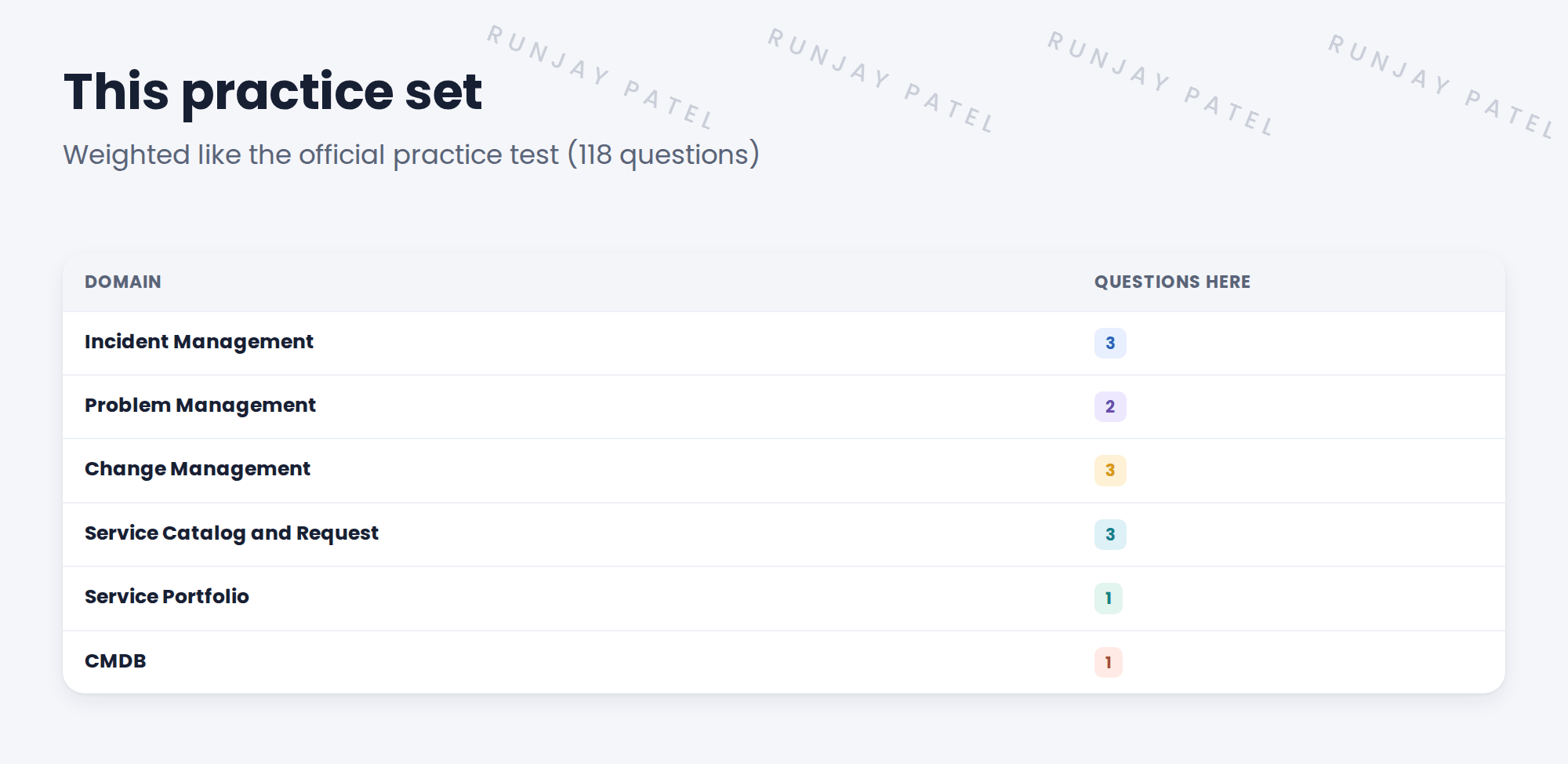
📝 Note: The real exam has 60 questions in 90 minutes. That’s about 90 seconds per question. Check the current exam guide before you book.
3 How to score it
| Score | What to do |
|---|---|
| 11 to 13 | You’re ready. Book the exam |
| 8 to 10 | Review the lessons you missed, then retake |
| 7 or fewer | Go back to the review lessons first |
💡 Good to know: Answer every question before you check any answers. That’s how the real exam feels.
4 Let’s try it: take the practice set
- Set a timer for 20 minutes.
- Answer all 13 questions below on paper, before opening any answer.
- Open each answer and mark yourself right or wrong.
- For each wrong answer, open the lesson named in the answer and read it again.
- Retake the set in two days. Aim for 11 or more.
5 Quick recap
- The set is weighted like the official practice test
- Answer everything before checking
- 11 to 13: book the exam
- Every answer names the lesson to review
- Retake after reviewing
6 Check yourself
Think of your answer first. Then tap to check.
1 Incident. Impact is 2 and urgency is 2 on the baseline matrix. What priority? Show answer
3 – Moderate. See Incident Configuration › Priority Design: Impact and Urgency.
2 Incident. Which On Hold reason fits when an agent is waiting for the caller to test a fix? Show answer
Awaiting Caller. See Incident Configuration › The Incident Lifecycle and On Hold Reasons.
3 Incident. Twenty people report the same outage. How should the incidents be linked? Show answer
One parent incident, with the others as children. See Incident Configuration › Incident Tasks and Parent/Child Incidents.
4 Problem. What is a known error? Show answer
A problem with a known root cause, and usually a workaround. See Problem Management › Known Errors and Workarounds.
5 Problem. Five incidents about the same issue arrive in a month. What kind of problem is opened from this trend? Show answer
A proactive problem. See Problem Management › Scoping Problem Management: Reactive and Proactive.
6 Change. Which change type uses a pre-approved template? Show answer
Standard. See Change Types › Normal, Standard and Emergency Changes at SNWR.
7 Change. What shows when changes are not allowed, like a quarter-end freeze? Show answer
A blackout schedule. See Change Risk › Maintenance Windows and Blackout Schedules.
8 Change. What decides who must approve a normal change? Show answer
A change approval policy, using type and risk. See Change Approvals › Change Approval Policies.
9 Catalog. Which record holds one ordered item and its variables? Show answer
The requested item (RITM). See Catalog Design › Request Architecture: REQ, RITM and SCTASK.
10 Catalog. You want to reuse the same three questions on 12 items. What do you build? Show answer
A variable set. See Catalog Design › Catalog Item Design Standards.
11 Catalog. Which tool orders several items from one set of questions? Show answer
An order guide. See Request Fulfillment › Order Guides for New Joiners.
12 Service Portfolio. What is a service offering? Show answer
One version of a service, with its own promise. See Service Portfolio › Services and Service Offerings.
13 CMDB. Which list on a change shows services that could be affected? Show answer
Impacted services. See CMDB Usage › Impact Analysis for Changes.
Nice work! You tested yourself like the real exam. 🎉
Next up: Final Walkthrough: SNWR ITSM End to End
Was this lesson helpful?
Please log in to share lesson feedback.
Have a question or doubt?
Ask here and get help from instructors and fellow learners.
Only logged-in learners can post.





