


The Foundation Data ITSM Needs, and Load Order
On this page
In this lesson, you will learn:
- What foundation data is
- Which foundation data ITSM needs
- The right order to load it
- What goes wrong if you load it in the wrong order
🔁 Quick look back: Last time: Stay Close to Baseline. You learned why staying close to the baseline keeps upgrades easy, and how to offer a baseline option instead of a custom one.
1 “Why is the Location field empty?”
Riya loads 1,500 SNWR users on snwrtest. Then she checks Sam Lee’s record.
- His Location is empty.
- His Department is empty.
- His Manager is empty too.
👉 The fix: load foundation data in the right order. Things that others point to go first.
2 What is foundation data?
Key term: Foundation data
The basic records every process needs: companies, locations, departments, users, groups and schedules.
Key term: Reference
A field that points to another record, like a user’s Location or Manager.
Tickets use foundation data all the time. An incident needs a caller (a user), an assignment group and an SLA schedule. Without good foundation data, nothing routes or measures correctly.
💡 Good to know: Need a refresher? See Fundamentals › Data Import.
3 The load order
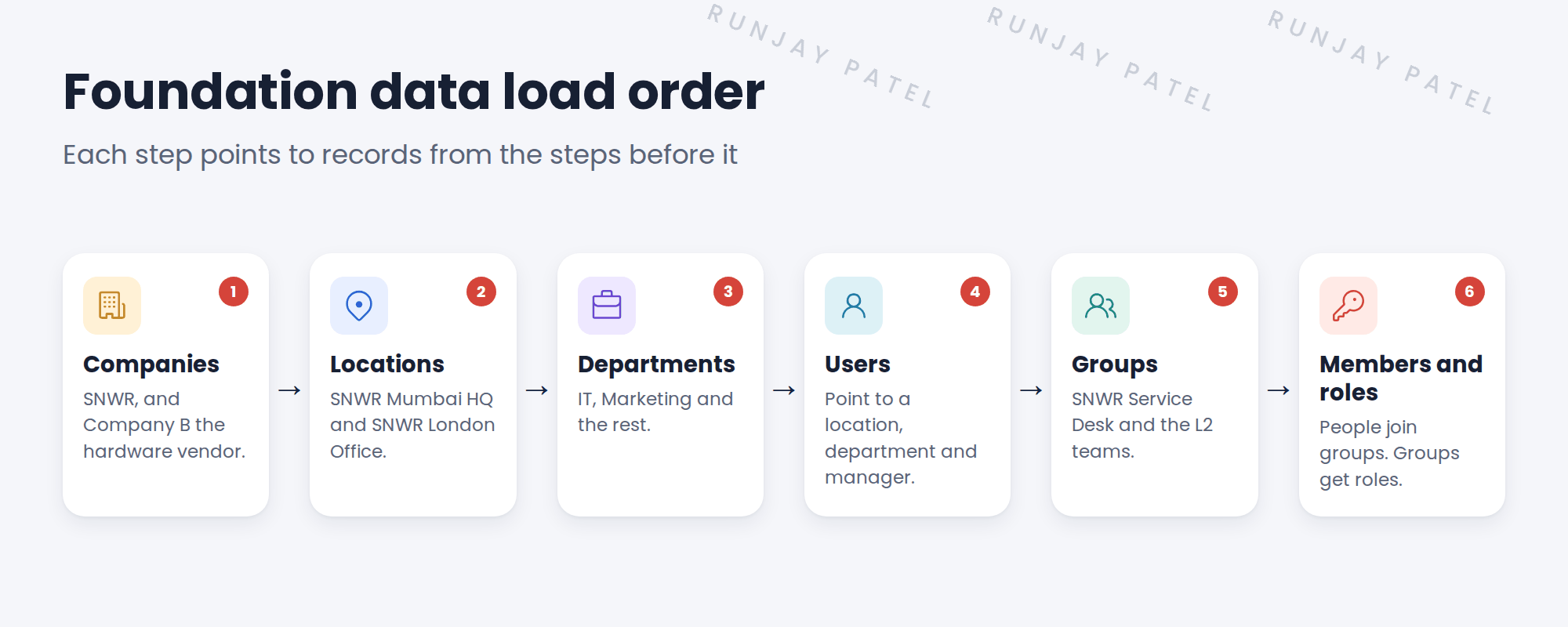
| Step | Why it comes here |
|---|---|
| Companies, locations, departments | Users point to them |
| Users | Groups need a manager, and managers are users |
| Groups | Group members and roles need the group to exist |
| Schedules | Can come any time before SLAs are built |
💡 Good to know: Managers are users too. Load all users first, then fill in the Manager field in a second pass.
4 Where the data comes from
- Most companies load users automatically from their company directory, every day.
- Locations and departments often come from the HR system.
- Groups and schedules are usually set up by hand, from the workshops.
⚠️ Heads up: Clean the data before you load it. Duplicate users and old leavers cause wrong assignments and wrong approvals later.
⭐ Remember: Companies, locations and departments, then users, then groups, then members and roles.
5 Quick recap
- Foundation data is the basic records every process needs
- Load records that others point to first
- Order: companies, locations, departments, users, groups, members and roles
- Users usually come from the company directory
- Clean the data before loading it
6 Check yourself
Think of your answer first. Then tap to check.
1 Why was Sam’s Location empty after the load? Show answer
The users were loaded before the locations existed, so the reference had nothing to point to.
2 Which comes first: users or groups? Show answer
Users. Groups need a manager, and managers are users.
3 Where do most companies get their user records from? Show answer
From the company directory, loaded automatically.
4 Name three kinds of foundation data. Show answer
For example: companies, locations, departments, users, groups and schedules.
Nice work! You know what foundation data ITSM needs, and in what order. 🎉
Next up: Locations, Departments and Companies
Was this lesson helpful?
Please log in to share lesson feedback.
Have a question or doubt?
Ask here and get help from instructors and fellow learners.
Only logged-in learners can post.





