


Domain-Wise Revision
On this page
In this lesson, you will learn:
- The must-know facts for each exam domain
- Which lessons to revisit for each one
- A simple three-week revision plan
1 Revise by domain
Don’t re-read the whole course. Go domain by domain, check the must-know facts, and revisit only the lessons you’re unsure about. 📋
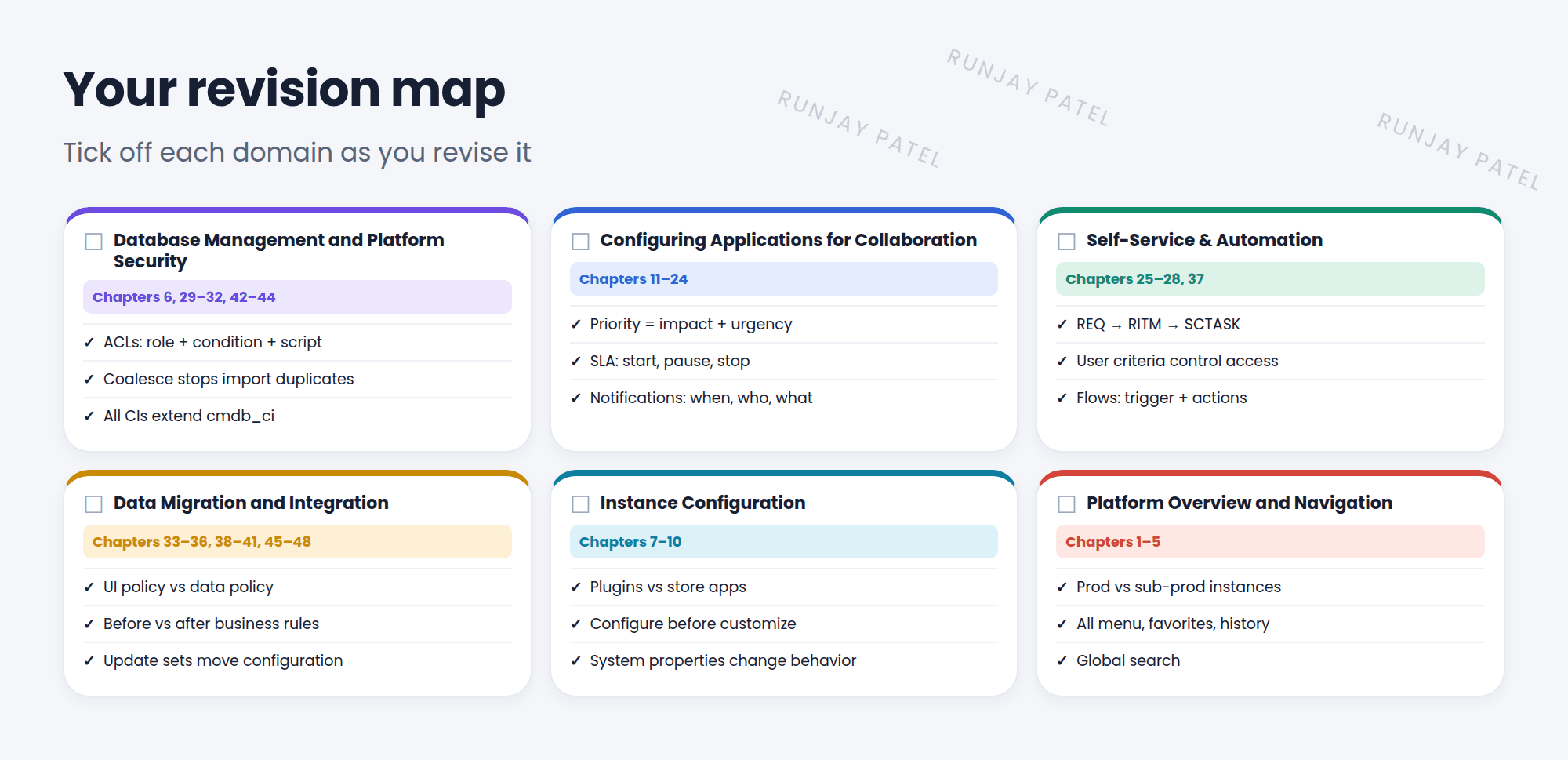
2 Must-know facts
| Domain | Must-know facts |
|---|---|
| Platform Overview and Navigation Ch 1–5 |
Instance types (prod and sub-prod). The All menu, favorites, and history. Global search. User preferences and impersonation basics. |
| Instance Configuration Ch 7–10 |
Plugins vs store apps. System properties. Configure vs customize. Next Experience, workspaces, and Service Portal. |
| Configuring Applications for Collaboration Ch 11–24 |
Filters, condition builder, and breadcrumbs. List and form layout, views, and related lists. Templates and save options. Task table, assignment rules, and approvals. Priority matrix. SLA start, pause, and stop. Report types and dashboards. Notifications: when, who, what. |
| Self-Service & Automation Ch 25–28, 37 |
Knowledge bases, article lifecycle, and user criteria. Catalog items, variables, and variable sets. REQ → RITM → SCTASK. Record producers and order guides. Flow triggers, actions, logic, and subflows. Catalog UI policies and Applies on. |
| Database Management and Platform Security Ch 6, 29–32, 42–44 |
Users, groups, and roles. Table extension and sys_id. Dictionary, overrides, and attributes. Reference fields and dot-walking. ACLs: role + condition + script, table then field. Import sets, transform maps, and coalesce. CMDB, CI classes, and CSDM. |
| Data Migration and Integration Ch 33–36, 38–41, 45–48 |
UI policy vs data policy. Client vs server scripts. Business rule timing: before, after, async, display. Update sets: what’s captured, retrieve, preview, commit. REST, SOAP, and MID Server basics. |
💡 Good to know: The exam loves “which is best” questions: UI policy or data policy, before or after rule, configure or customize. Revise the comparison lessons (like 34.2, 36.4, and 39.2) twice.
3 A three-week plan
| Week | Focus |
|---|---|
| Week 1 | Your weakest domains first. Redo their “Let’s try it” steps on your PDI |
| Week 2 | The biggest domains: Database Management and Platform Security, Collaboration, and Self-Service & Automation |
| Week 3 | Practice questions (Lesson 49.3), a full mock exam (Lesson 49.4), and quick reviews of anything you missed |
📝 Note: Every lesson ends with a Quick recap and Check yourself. Reading just those sections is a fast way to review a whole chapter.
⭐ Remember: Revise by domain. Start with your weakest, spend the most time on the biggest, and practice on your PDI.
4 Let’s try it: rate every fact
- Read the must-know facts for each domain in the table above.
- For each fact you can’t explain in one sentence, write down the chapter number.
- Revisit those lessons this week, and redo their “Let’s try it” steps.
5 Quick recap
- Revise domain by domain, not front to back
- Use the must-know facts to find your gaps
- Comparison topics come up a lot
- Week 1: weak spots. Week 2: big domains. Week 3: practice and mock exam
6 Check yourself
Think of your answer first. Then tap to check.
1 Which domain covers ACLs, importing data, and the CMDB? Show answer
Database Management and Platform Security.
2 Which domain covers update sets and business rules? Show answer
Data Migration and Integration.
3 What’s a fast way to review a whole chapter? Show answer
Read each lesson’s Quick recap and Check yourself sections.
Nice work! You finished this lesson. 🎉
Was this lesson helpful?
Please log in to share lesson feedback.
Have a question or doubt?
Ask here and get help from instructors and fellow learners.
Only logged-in learners can post.





